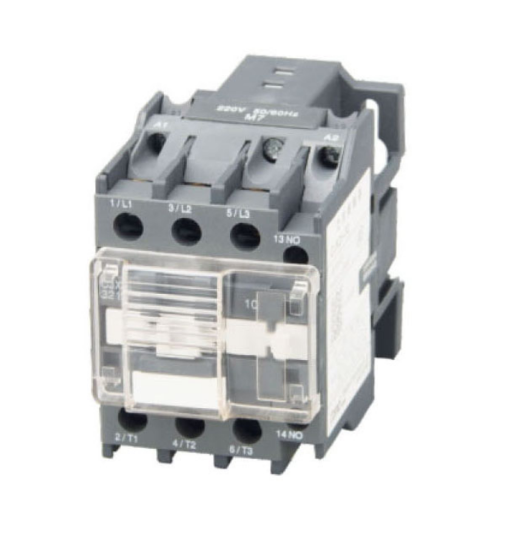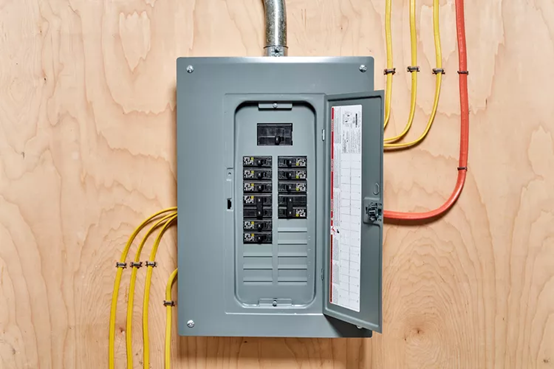
In energy storage applications, a device is required to manage the transition between grid-tied and off-grid modes. The core component of such a device is a transfer switch. Since both STS (Static Transfer Switch) and ATS (Automatic Transfer Switch) are types of transfer switches, which one should be chosen?
What is Grid-Tied to Off-Grid Switching?
Most current industrial and commercial energy storage projects operate in a grid-tied configuration, integrated into factories or industrial parks for purposes such as peak-valley arbitrage and demand-side management. However, in regions with less reliable power infrastructure—where outages or power rationing are common—there is a growing demand among businesses and industrial parks for off-grid power supply capabilities. This necessitates the use of a grid-tied/off-grid transfer switch.
Grid-Tied Mode: The load is powered by a combination of the energy storage system (ESS)/photovoltaic (PV) array and the utility grid. During periods of high electricity prices, the load is powered by the ESS or PV system; during periods of low prices, it is powered by the utility grid.
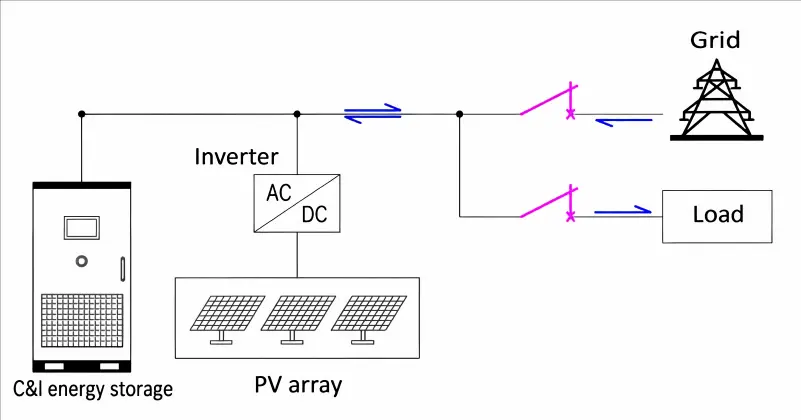
Off-Grid Mode: The load is powered exclusively by the ESS or PV system, with the connection to the utility grid disconnected.
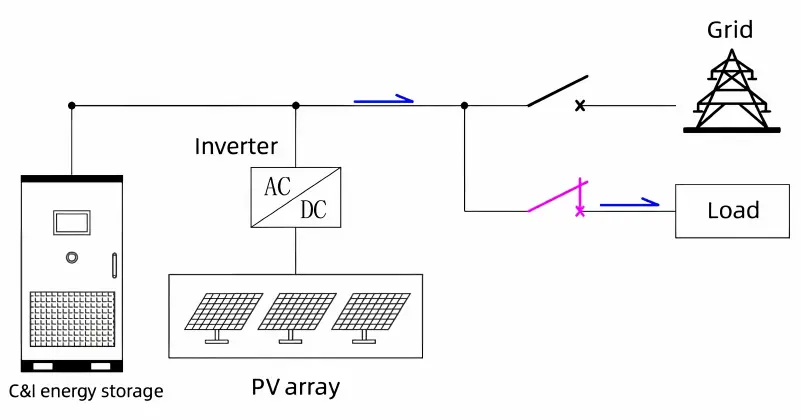
Choosing Between STS and ATS for Grid-Tied/Off-Grid Switching
First, let us define what STS and ATS are:
An ATS (Automatic Transfer Switch)—also known as a dual-power transfer switch—is essentially a mechanical switch. It features two circuits: a primary (main) circuit and a backup (secondary) circuit (as shown in the diagram below). When the primary power source is functioning normally, the primary circuit remains closed, supplying power to the load. If an anomaly is detected in the primary power source, the ATS disconnects the primary circuit and closes the backup circuit, allowing the backup power source to supply the load.
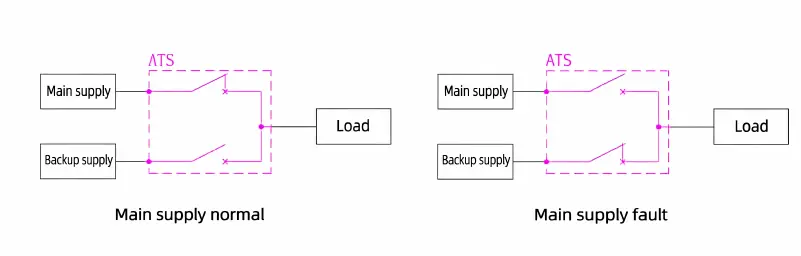
An STS (Static Transfer Switch) is an electronic switch. It utilizes semiconductor devices, such as thyristors, in place of mechanical contacts. In the event of a grid anomaly, it can rapidly disconnect the utility grid. It is important to note that an STS does not inherently include a backup circuit.
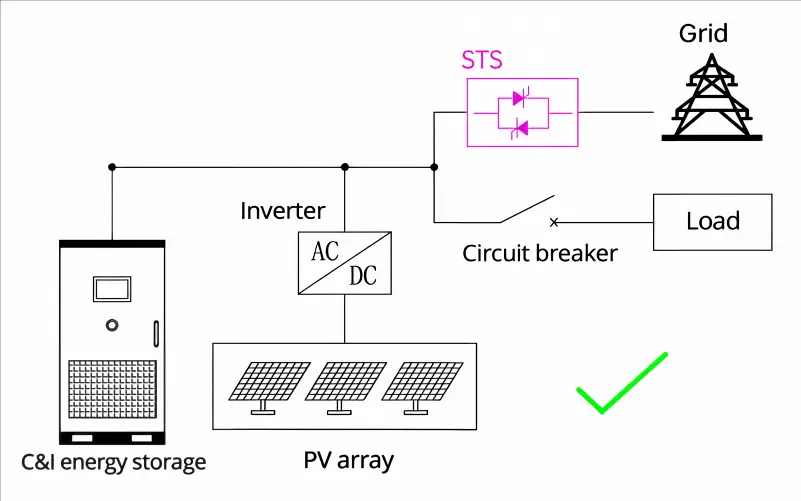
As indicated in the overview of grid-tied/off-grid switching, when a grid anomaly occurs, the circuit breaker on the utility grid side must be disconnected immediately. When the power grid recovers, the grid-side circuit breaker must be closed. An STS (Static Transfer Switch) possesses the capability to detect grid status and automatically disconnect or reconnect, making it an ideal replacement for a standard grid-side circuit breaker in grid-tied/off-grid topologies. Furthermore, thanks to its high-speed switching capability, the load experiences no power interruption during the transition—a scenario that would inevitably result in a power outage if a mechanical switch were used instead.
Application of ATS in Energy Storage Projects
While the STS is clearly the optimal solution for grid-tied/off-grid switching, can an ATS (Automatic Transfer Switch) still be utilized in energy storage projects? The answer is yes.
For applications where power supply reliability is critical—such as in hospitals or facilities involving precision instrument manufacturing—energy storage systems are often supplemented by an additional backup power source. This dual-protection strategy ensures enhanced reliability. How is this implemented?
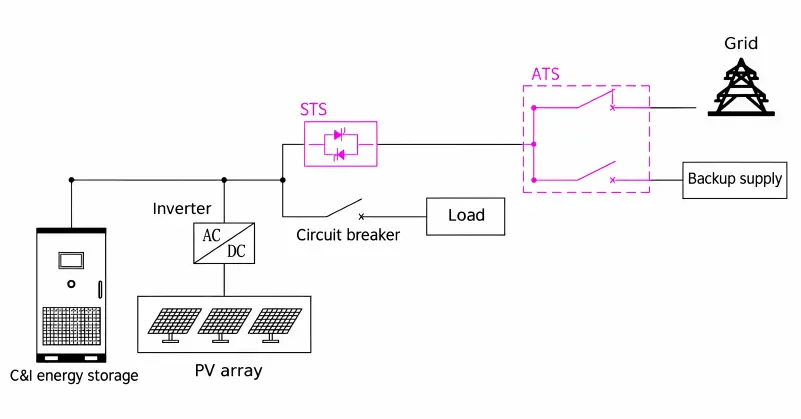
As shown in the diagram above, when an anomaly occurs in the power grid, the STS reacts immediately, disconnecting the grid connection. The energy storage system then shifts to off-grid mode, supplying power to the load and ensuring no interruption. Simultaneously, the ATS detects the grid anomaly, disconnects from the main grid, and engages the backup power source.
This dual-supply configuration ensures a continuous flow of power to the load: the energy storage system provides power for a duration measured in hours, while the backup power source offers long-term supply, thereby guaranteeing stability during grid disturbances. Please note that this topology is provided for reference only; actual engineering applications require the consideration of additional factors.