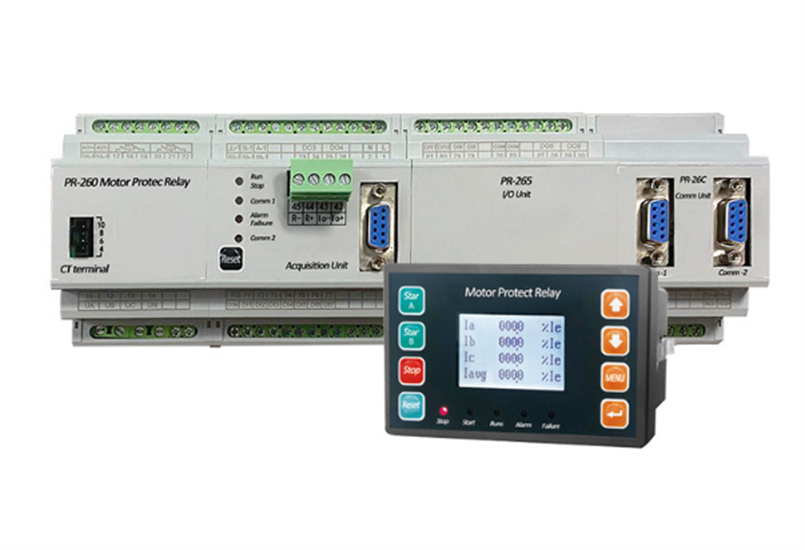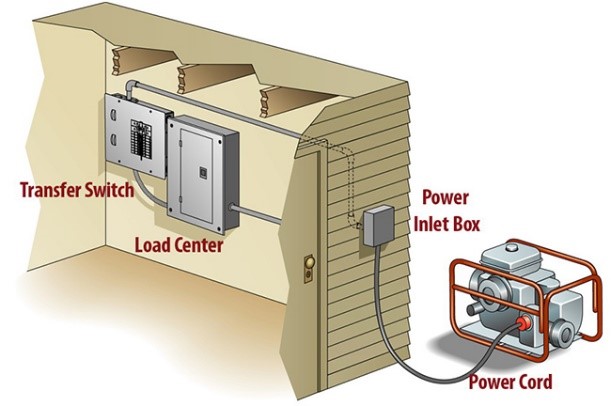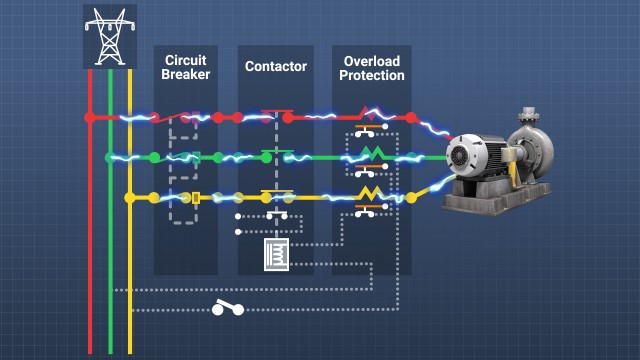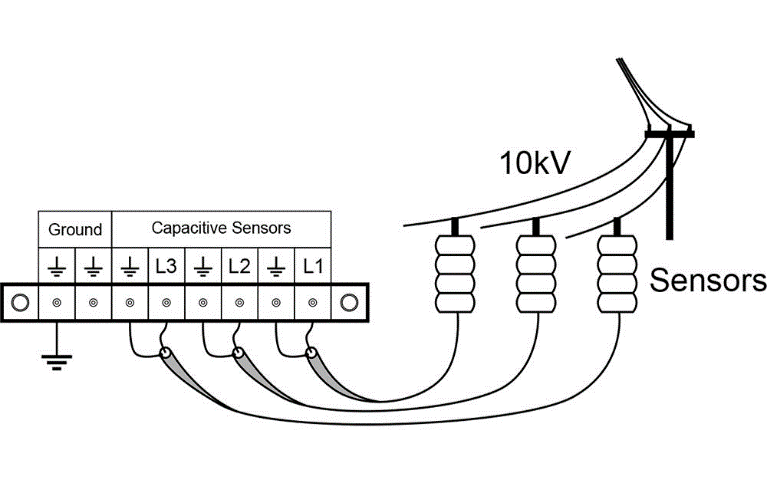
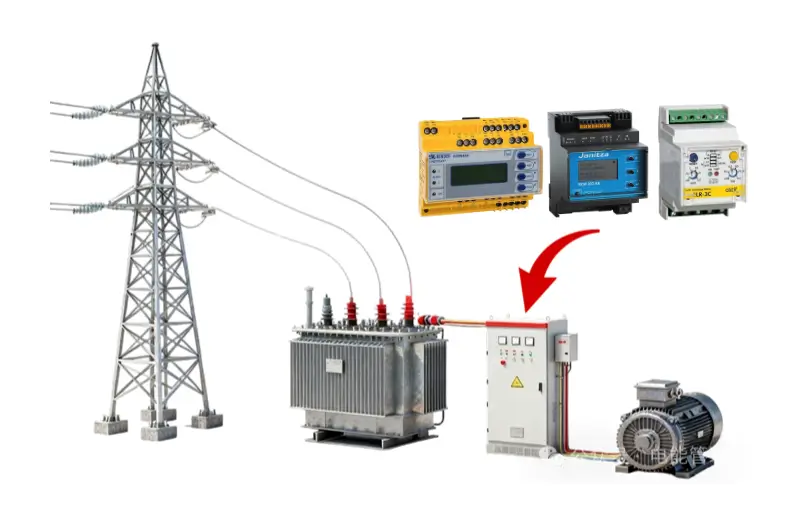
The earth leakage protection relay itself cannot directly interrupt the main circuit; it operates in conjunction with a leakage current transformer and a controller. Installed on the generator’s main output circuit, it is a mandatory safety device for construction site, mobile vehicle-mounted, and stationary generator sets.
Working Principle of Diesel Generator Earth Leakage Protection Relays
This device is designed for three-phase, four-wire TN/TT systems. The generator’s L1, L2, L3, and N cables must all pass through the leakage current transformer, while the PE (protective earth) wire and the generator housing’s grounding wire must not pass through it. During normal operation, the vector sum of the currents in the three phases and the neutral wire is zero; the transformer generates no signal, and the relay remains inactive.
In the event of earth leakage or a ground fault, a portion of the fault current returns via the earth or PE wire, causing a current vector imbalance. The transformer detects this residual current, and the controller compares it against a preset threshold. Once the threshold is exceeded, the controller outputs a passive switch signal, which can trigger audible and visual alarms, activate a circuit breaker shunt trip, and initiate generator shutdown for protection.
Selection Criteria for Diesel Generator Earth Leakage Protection Relays
Leakage Type
When selecting a residual current protection device for a diesel generator set, the leakage type is a critical parameter: Type AC is suitable only for pure AC resistive loads (such as general lighting) and is prone to nuisance tripping in applications involving variable frequency drives (VFDs) or motors, so it is not recommended. Type A detects both AC and pulsating DC leakage currents and is compatible with common loads such as motors, UPS systems, VFDs, and water pumps, making it the preferred choice for standard diesel generator sets. Type B can detect smooth DC leakage currents and is primarily used in specialized, high-power generator projects involving EV charging stations or high-power rectifier loads.
Graded Setting of Operating Current (Tiered Protection for Main Circuits)
When configuring tiered protection settings for main circuits, compliance with temporary power supply standards for construction sites is required. Time-delay protection is selected for the diesel generator’s main incoming line to ensure selective tripping coordination between upstream and downstream devices; terminal equipment and handheld tools are equipped with instantaneous protection (30 mA rating, operating time ≤0.1 s) for direct personnel safety.
The setting current for the primary protection at the diesel generator’s main output cabinet is adjustable within the 0.1–3 A range, with a time delay of 0.2–2 s. Recommended settings are 100–300 mA for small units (≤100 kW) and 0.5–1 A for high-power units (≥200 kW) or those utilizing long-distance multi-cable runs. For critical emergency diesel generators, a 50 mA alarm threshold and a 300 mA trip threshold may be configured to enable a “warn-before-trip” sequence; settings must ensure the operating current is at least twice the unit’s normal inherent leakage current to prevent nuisance tripping during no-load or long-cable operating conditions.
Transformer Selection
Split-core (openable) zero-sequence current transformers are preferred, offering distinct advantages for retrofitting existing units as they can be installed directly around cables without cutting them. Transformers with a 45 mm aperture are suitable for units rated at 80 A or less; an 80 mm aperture is selected for 250 A units; apertures of 100–150 mm match 400–630 A units; and rectangular split-core transformers are used for high-current busbar cabinet applications.
Installation Methods
The leakage current relay offers two installation options: a 35 mm DIN-rail mount for compact installation inside control cabinets, and a panel-mount option for installation via a cutout in the diesel generator control panel (featuring an LCD for real-time leakage current display). Optional features include RS485 remote data transmission, remote reset, fault logging, and dual-channel output capabilities (one channel for alarms and one for tripping/shutdown).
Earth Leakage Relays vs. Insulation Monitoring Devices in Diesel Generators
There are distinct differences regarding the systems to which earth leakage relays and insulation monitoring devices are applied in diesel generator setups. Earth leakage relays are suitable for TN and TT systems (where the neutral point is grounded); they detect fault leakage currents and trigger alarms or trip the circuit upon a fault. Characterized by low cost and the ability to directly shut down the generator unit, they are the standard choice for temporary power supply at construction sites. In contrast, insulation monitoring devices are used in IT systems (ungrounded/isolated neutral) for emergency diesel generators and in applications requiring uninterruptible power, such as hospitals and fire safety systems. They operate by monitoring insulation resistance to ground in real-time, issuing early warnings when insulation performance degrades; however, they can only provide alarms and cannot directly execute a trip operation, and the equipment cost is relatively higher.
Conclusion
Standard diesel generator control cabinets typically utilize Type A earth leakage protection relays. The generator output connects sequentially to a split-core zero-sequence current transformer and a Type A time-delay earth leakage relay. In the event of minor leakage (under 50mA), the device triggers only an audible and visual alarm without tripping, thereby ensuring the continuity of the emergency power supply. However, if a severe ground fault exceeding 300mA occurs, the system trips the main molded-case circuit breaker after a 0.3-second delay, simultaneously shutting down the generator for protection.