Cables are generally categorized into shielded and unshielded types, depending on whether they incorporate a shielding layer. These two types differ in terms of their construction, resistance to electromagnetic interference (EMI), intended applications, and cost.
So, what exactly distinguishes shielded cables from unshielded cables, and how should one choose between them for practical applications?
What Is a Shielded Cable?
A shielded cable is a cable that features an additional shielding layer surrounding its conductors. Common shielding structures include aluminum foil, braided copper wire, or a combination of both.
The shielding layer is typically made of conductive material. Its primary purpose is to minimize the impact of external electromagnetic interference (EMI) on the signals carried within the cable, while also reducing the emission of electromagnetic signals from the cable itself.
Different shielding structures offer distinct characteristics:
Aluminum Foil Shielding: Provides extensive coverage and a high degree of shielding integrity; commonly used in signal and communication cables.
Braided Copper Shielding: Offers superior mechanical strength and flexibility, making it suitable for environments that require both interference resistance and mechanical durability.
Combination Shielding (Foil and Braid): Integrates the advantages of both types, providing more comprehensive shielding performance.
Shielded cables are frequently used in industrial automation, instrumentation, data communication, variable-frequency drive (VFD) control, and other environments characterized by high levels of electromagnetic interference.
It is important to note that the effectiveness of the shielding depends not only on the materials and structure used but also on how the shield is grounded, the quality of the connections, and the installation method.
What Is an Unshielded Cable?
An unshielded cable is one that lacks a dedicated electromagnetic shielding layer; it typically consists of conductors, an insulating layer, and an outer jacket.
Compared to shielded cables, unshielded cables feature a simpler construction and generally offer the following characteristics:
Lower Cost: Due to their simpler design, both the materials and manufacturing costs are relatively low.
Ease of Installation: These cables are typically lighter and more flexible, making them easier to route and install.
Broad Applicability: They are suitable for general power supply, lighting, and standard control circuits. Unshielded cables are suitable for environments with minimal electromagnetic interference (EMI), where the cabling layout is well-planned and signal transmission requirements can be met. However, when used in the vicinity of EMI sources—such as variable-frequency drives (VFDs), motors, or high-power switching equipment—it is necessary to evaluate the potential impact of electromagnetic interference on signal transmission.
Shielded Cable vs. Unshielded Cable: What Is the Difference?
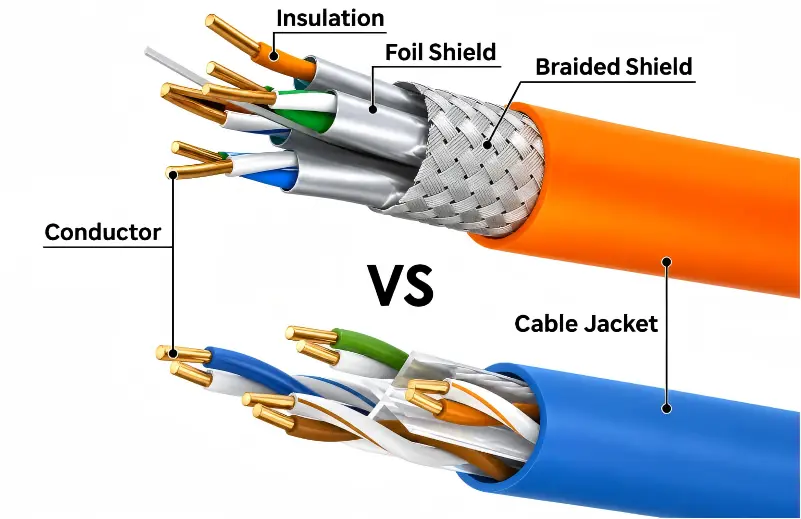
The primary distinction between shielded and unshielded cables lies in the presence or absence of a shielding layer. Consequently, the two types differ in terms of their resistance to electromagnetic interference, physical construction, installation requirements, and suitable application scenarios.
| Comparison Criteria | Shielded cable | Unshielded cable |
| Structural Composition | Composed of a conductor, an insulation layer, a shielding layer, and a sheath; the shielding layer typically consists of aluminum foil, copper wire braiding, or a combination of both. | Composed of conductors, an insulating layer, and a sheath; lacks a shielding layer. |
| Primary Function | Reduces the impact of external electromagnetic interference on signals, enhancing the stability of signal transmission. | Handles basic transmission tasks such as general power supply, lighting, and on/off (discrete) control. |
| Anti-Interference Capability | Highly robust; suitable for industrial environments with a high density of equipment such as motors, variable-frequency drives (VFDs), servo systems, and switching power supplies. | Low interference immunity; suitable for areas with minimal interference and simple circuit layouts. |
| Compatible Signals | Used for analog signals, sensors, encoders, servo feedback, RS-485, CAN, Profibus, etc. | General power supply, lighting, electrical outlets, short-distance on/off control, and simple control circuits. |
| Transmission Distance | Suitable for longer-distance transmission of weak signals and communication lines. | Suitable for short-distance runs and applications with low sensitivity to interference. |
| Installation Requirements | Requires proper handling of shield grounding; termination requirements are more stringent. | Simple wiring; allows for rapid installation. |
| Grounding Requirements | The shield must be grounded in accordance with equipment manuals and on-site grounding specifications—typically via single-ended or double-ended grounding. | No issues regarding shield grounding; installation follows standard protective grounding and electrical wiring codes. |
| Cabling Requirements | Must be routed separately from power lines, variable-frequency drive (VFD) output cables, and servo power cables. | Standard cabling can be routed along conventional paths, provided that the principle of separating high-voltage/high-power lines from low-voltage/signal lines is maintained. |
| Cost | Material and installation costs are higher than those of unshielded cables. | Low cost; ideal for general-purpose wiring and large-scale installations. |
| Maintenance Challenges | Shield fractures, poor grounding, or improper termination can lead to latent (hidden) faults. | Fault locations are relatively easy to identify, simplifying troubleshooting. |
| Common Issues | Issues such as an ungrounded (floating) shield, stray wire strands touching terminals, excessively long “pigtail” (braided wire) ground connections, or routing low-voltage signal cables in the same conduit/tray as high-voltage power lines should be avoided. | In environments with electromagnetic interference, it may lead to signal fluctuations, unstable communication, or data drift. |
| Selection Criteria | Select this option when weak signals, communication, measurement, feedback, or sources of interference are present. | Recommended for general power supply, lighting, short-distance discrete (on/off) signaling, and basic control applications. |
| Application Scenarios | In industrial environments characterized by high levels of electromagnetic interference—such as those involving variable frequency drives (VFDs), motors, servo drives, high-power power supplies, or frequently operating contactors—certain types of signal lines are particularly susceptible to interference. These include analog sensor cables (for pressure, temperature, flow, level, or weighing), encoder and servo feedback pulse lines, communication cables (RS-485, CAN, Profibus), VFD control and analog reference/feedback lines, as well as any low-voltage signal lines that span long distances or pass through areas densely packed with equipment. For all such circuits, the use of shielded cables is recommended. | For general-purpose electrical circuits—such as those for standard lighting, power supply, electrical outlets, and short-distance switching control—use unshielded cables. |
Conclusion
Shielded cables are not a universal solution, nor are unshielded cables necessarily inferior. The distinction between the two lies not in their quality tier, but in their intended application.
Shielded cables are suitable for environments characterized by high interference, weak signals, long transmission distances, or requirements for high precision. Unshielded cables are appropriate for general power supply, lighting, simple control tasks, and settings with minimal interference.