The Impact of Moisture on Switchgear
The primary function of switchgear is to perform switching, control, and protection duties for electrical equipment throughout the processes of power generation, transmission, distribution, and energy conversion within a power system. Enclosed high-voltage switchgear is widely deployed in switching stations, residential distribution rooms, and substations, owing to its advantages of safety, reliability, compact structure, minimal footprint, and ease of operation.
However, the extensive use of organic insulating materials within these units—combined with their highly compact layouts and high degree of airtightness—has brought to the forefront the issue of moisture-induced switchgear failures.
Among switchgear units operating at voltage levels ranging from 10 kV to 35 kV, faults caused by moisture exhibit the highest incidence rate. Moreover, a particularly prominent phenomenon in these systems is that a fault occurring in a single unit often cascades, adversely affecting adjacent switchgear units as well.
What Causes Moisture in Switchgear
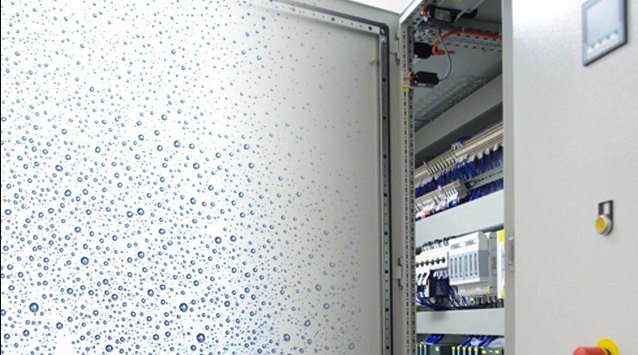
In urban switching stations, residential distribution rooms, and substations, cable trenches (or tunnels) constructed alongside major thoroughfares are widely utilized for laying cables. Consequently, moisture ingress from these cable trenches (or tunnels) constitutes one of the primary causes of internal condensation within switchgear cabinets.
Furthermore, ambient humidity is another major contributing factor to condensation formation inside switchgear. When condensation occurs within the switchgear, it can trigger surface creepage and flashover incidents; in severe cases, this may directly lead to the cabinet catching fire and burning down, resulting in major safety accidents.
High-Voltage Switchgear Dehumidification Control Solution
To prevent the switchgear condensation or control the switchgear humidity, we recommend installating electrical cabinet dehumidifier.
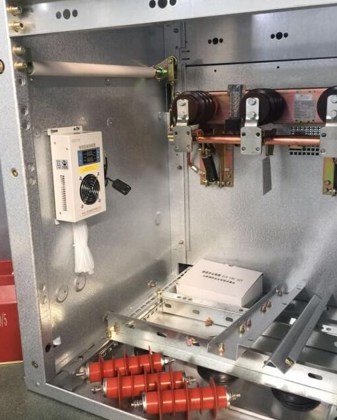
Installation of a Drainage-Type Dehumidifier Inside the Cabinet
The operating principle of this dehumidification method is as follows: Humid air is drawn in by a fan and flows through a specially designed air duct. It first passes over a semiconductor cooling element, where it is cooled to its dew point and condenses. The condensate formed on the cooling element drips—driven by gravity—into a collection trough, from which it is then channeled out of the cabinet via a drainage tube.
Through a complete dehumidification cycle—triggered within a preset humidity threshold—the air humidity inside the cabinet is reduced below the dew point, thereby completing the entire moisture-control and anti-condensation process. Furthermore, the intelligent dehumidification unit features externally mounted sensors that accurately monitor the actual humidity inside the cabinet in real time. This ensures that the unit activates proactively to initiate dehumidification whenever internal conditions approach the dew point, thereby preventing condensation before it occurs.
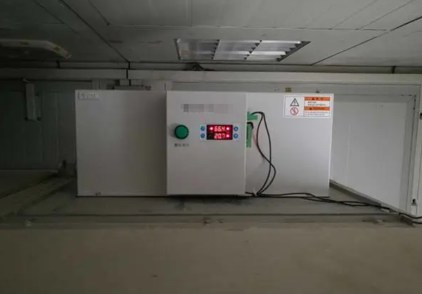
Installation of a Cabinet-Top Atomizing Dehumidifier
The cabinet-top dehumidification unit utilizes microprocessor control and represents a high-tech product specifically developed to address the unique environmental challenges within power equipment—particularly 10kV and 35kV switchgear. Designed to improve the internal temperature and humidity conditions, it is tailored to environments characterized by compact internal spaces, high ambient temperatures and humidity levels, and significant temperature fluctuations.
The core components of the device consist of an intelligent control unit, an environmental monitoring unit, and a communication module. Based on real-time site conditions, the unit automatically regulates the internal humidity. Moisture removal is achieved either through forced evaporation via an atomizing unit or, alternatively, by channeling the water out of the cabinet via a connected drainage pipe.
Drainage-Type Dehumidifier vs. Traditional Heating Dehumidifier
| Comparison | Drainage-Type Dehumidifier | Traditional heating dehumidifier |
| Working Principle | Humid hot air condenses when cooled. The fan forces humid hot air through the built-in cold end of the device, where moisture condenses into water, which is then collected and drained out of the cabinet. This reduces the moisture content and humidity inside the cabinet. Advantage: Directly removes moisture from the cabinet by condensing it into water, significantly reducing internal humidity. Even if the external environment cools sharply, there is insufficient moisture left to form condensation. | Warmer air can hold more moisture. Heating air keeps potential condensation moisture suspended in the air, preventing it from condensing on equipment surfaces. Disadvantage: Moisture remains inside the cabinet. If the external environment cools sharply, the moisture will still condense, endangering equipment operation safety. |
| Safety | The product housing does not generate heat, so it has no impact on surrounding cables. | The product housing becomes very hot during operation, accelerating the aging of the surrounding cables. Direct contact with cables can even damage cable insulation and compromise safety. |
| Energy Efficiency | Automatically starts when the cabinet humidity reaches the threshold, stops automatically after dehumidification, and completes dehumidification in a short time. Taking 60W as an example: 2 hours of operation per day, 10W standby for the rest of the time, the annual power consumption is 124 kWh. | Requires high power to maintain a constant temperature inside the cabinet and for long-term operation. Taking 100W as an example, annual power consumption is 876 kWh. |
| Structure | Integrated design of moisture detection and dehumidification, no wiring required. | Split design of moisture detection and dehumidification, requiring wiring between the two components. |
Conclusion
Moisture ingress and condensation pose severe, high-incidence risks to 10–35kV enclosed switchgear, driven by cable trench moisture penetration and high ambient humidity, which can trigger flashover, fire, and cascading system failures. Drainage-type dehumidifiers, leveraging active condensation and moisture removal, deliver a far more reliable, energy-efficient, and safe solution than cabinet-top atomizing (heating-based) dehumidifiers. With integrated design, zero thermal impact on cables, and proactive anti-condensation control, drainage-type systems fundamentally eliminate moisture hazards, ensuring the long-term stable operation of switchgear in power distribution and substation environments.