Effective thermal management is essential to maintain stable operation, prevent overheating, and extend the service life of electrical enclosures and internal electronic components. In industrial applications, both active cooling and passive cooling are the two mainstream thermal solutions for electrical cabinets.
Choosing the wrong cooling method may lead to component aging, equipment failure, and unexpected downtime. This article clearly explains the definition, core differences, applicable scenarios, and practical selection principles of active and passive enclosure cooling, helping users quickly determine the most suitable cooling solution for different electrical enclosures.
What is active cooling for electrical enclosures?
Active cooling for electrical enclosures uses external power to drive temperature control components such as cooling fans, cabinet air conditioners, heat exchangers, temperature-controlled heaters, and cabinet dehumidifiers. It efficiently removes heat generated by components through forced convection and refrigerant circulation. By overcoming the limitations of natural heat dissipation, its cooling effect is not constrained by ambient temperature or the cabinet’s protective structure. It is the mainstream temperature control solution for high-power electrical enclosures with densely packed components.
Active cooling for electrical enclosures uses external power to drive temperature control components such as cooling fans, cabinet air conditioners, heat exchangers, temperature-controlled heaters, and cabinet dehumidifiers. It efficiently removes heat generated by components through forced convection and refrigerant circulation. By overcoming the limitations of natural heat dissipation, its cooling effect is not constrained by ambient temperature or the cabinet’s protective structure. It is the mainstream temperature control solution for high-power electrical enclosures with densely packed components.
What is passive cooling for electrical enclosures?
Passive cooling for electrical enclosures requires no electricity or moving mechanical parts. It relies on three natural heat transfer principles: conduction, convection, and radiation. Through cabinet ventilation openings, radiators, radiative cooling, phase change materials, and optimized cabinet structure and component arrangement, the heat generated by the components is spontaneously transferred to the outside of the cabinet by utilizing the natural temperature difference between the inside and outside. This solution is often used in small distribution boxes, junction boxes, and simple indoor control cabinets with low heat loads.
Active vs. Passive Cooling for Electrical Enclosures – What’s the Difference?
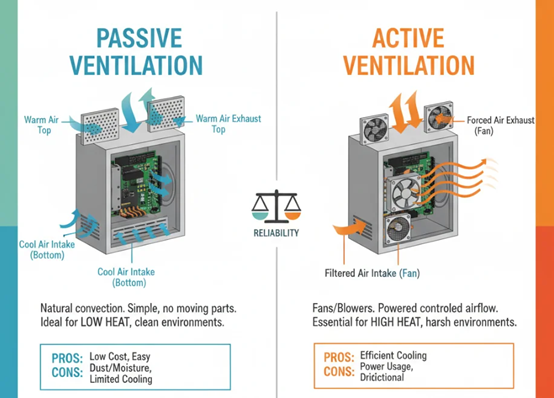
Active cooling relies on electrically powered fans, cabinet air conditioners, heat exchangers, and other equipment to achieve forced heat exchange. Passive cooling relies on conduction, natural convection, and heat radiation for passive heat dissipation. The two differ significantly in heat dissipation capacity, temperature control accuracy, energy consumption, environmental adaptability, installation and maintenance, and applicable cabinet types.
Heat Dissipation Capacity: Active cooling has a high upper limit for heat dissipation, capable of handling cabinets with dense components and high heat power. Even in sealed IP54/IP65 cabinets and high-temperature workshop environments, it can maintain stable temperature control. Passive cooling is limited by the cabinet surface area and ambient temperature difference, and can only handle low heat loads. Its heat dissipation efficiency drops significantly when the ambient temperature is high or the cabinet is sealed.
Temperature Control: Active cooling can be equipped with temperature control components for precise temperature control, avoiding high and low temperature failures and condensation problems for components. Passive cooling lacks temperature control capabilities, and the temperature inside the cabinet fluctuates synchronously with the external environment and equipment load.
Energy Consumption and Noise: Active cooling equipment continuously consumes electricity, and the operation of fans and compressors generates noise. Passive cooling consumes zero additional energy and operates silently. Construction and Maintenance: Active cooling requires wiring and cabinet modifications, and filters, compressors, and other components require regular inspection and maintenance. Passive cooling is simple to retrofit and requires almost no maintenance, only occasional cleaning of ventilation debris.
Application Scenarios: Active cooling is mostly used in high-power frequency converter cabinets, outdoor enclosed electrical control systems, and control cabinets for harsh operating conditions. Passive cooling is suitable for low-power distribution boxes, small indoor control boxes, and unattended low-voltage electrical boxes in the field.
Active vs. Passive Cooling – Which is Suitable for Your Electrical Enclosure
Passive Cooling for Small Electrical Enclosures
1. Indoor Low-Voltage Small Distribution Cabinets: Ordinary lighting distribution boxes, local terminal boxes, small circuit breaker control cabinets. Components inside the cabinet generate less than 50W of heat. Suitable for well-ventilated environments with room temperatures of 20-35℃, relying on cabinet louvers and natural convection for heat dissipation.
2. Low-Power Low-Voltage Control Cabinets: Small PLC control cabinets, signal acquisition boxes, security control boxes, instrument adapter boxes. Components have low power consumption, no high-power transformers/contactors, suitable for clean indoor environments.
3. Unattended Miniature Electrical Control Boxes in the Field: Small enclosures for field hydrology and photovoltaic power generation, remote sensing control boxes. Ideal for remote locations with limited maintenance capabilities and where regular heat dissipation checks are impossible. Prioritize maintenance-free passive cooling.
4. Electrical Control Systems for Quiet Environments: Electrical boxes built into laboratories, offices, and central control consoles. Suitable for sites with noise control measures in place, prohibiting noise from fans and refrigeration equipment.
5. Low-Power Inverter/Drive Boxes in Ambient Temperature and Ventilation Environments
Low-power servo drives (≤1.5kW), simple fan control boxes, in workshops with good ventilation and ambient temperatures not exceeding 35℃ year-round.
Active Cooling for Large Electrical Enclosures
1. High-Power Drive Inverter Cabinets, Inverter Control Cabinets
High-power inverters, soft-start cabinets, multi-axis servo cabinets, with components generating significant heat (hundreds to thousands of watts), are the most common application for active cooling, often using cabinet air conditioners and cooling fans.
2. IP54/IP55/IP65 Outdoor Sealed Electrical Cabinets
Outdoor distribution cabinets, wind turbine pitch control cabinets, outdoor photovoltaic grid-connected cabinets, with fully sealed enclosures that cannot be naturally ventilated, exposed to dust and rain, requiring cabinet air conditioners or heat exchangers.
3. High-Temperature Industrial Cabinets
Electrical control cabinets in metallurgical, heat treatment, and forging workshops, where ambient temperatures consistently >40℃, and natural cooling is impossible.
4. Precision Instrument and Industrial Control System Cabinets
Cabinets for precision testing instruments, robot control cabinets, and servo system control cabinets. Components are temperature-sensitive and require constant temperature (±2~3℃), relying on air conditioning for precise temperature control.
5. Cabinets in Workshops with High Dust and Corrosive Gases
Distribution cabinets in chemical, paper, and cement plants. High levels of dust and corrosive gases prevent ventilation holes; sealed heat exchangers and cabinet air conditioners are standard.
6. High-Density Integrated Distribution Cabinets
Multi-circuit meter cabinets, modular power supply cabinets, and power cabinets for data centers. Components are compactly arranged with high heat flux density, making natural heat dissipation insufficient.
Passive + Active Hybrid Cooling for Medium Electrical Enclosures:
This is the preferred solution for most medium-power electrical cabinets. Basic heat generation is passively handled by heat sinks and natural ventilation. Temperature-controlled fans are installed inside the cabinet. The fans stop at low loads (passive cooling) and automatically start during peak temperatures (active reinforcement), balancing energy saving, quiet operation, and heat dissipation redundancy, reducing overall electricity costs and failure rates.
rates.
How to Choose the Right Cooling Solution for Electrical Enclosures
Heat Load Inside the Electrical Cabinet: Calculate the total rated heat output of all components inside the cabinet: For total power consumption < 50W (low heat output), passive cooling is preferred; for 50~300W (medium heat output), a hybrid solution of passive cooling + small fan can be used; for >300W (high heat load), fully active cooling (fan/cabinet air conditioner) is required.
Ambient Temperature Outside the Cabinet: Indoor ambient temperature (20~30℃), clean ventilation: passive heat dissipation or simple fan active cooling is preferred; In outdoor open-air/high-temperature workshops (ambient temperature > 38℃), dust, oil, corrosive gases: for sealed cabinets, directly select a cabinet air conditioner; for semi-open cabinets, choose active cooling with a fan and dust filter, abandoning purely passive solutions.
IP Protection Rating of Electrical Cabinets: Fully sealed cabinets with IP54 and above cannot achieve natural air convection and cannot use passive cooling alone; active cooling such as air conditioning or closed-loop heat exchangers must be used; open cabinets with IP30 and below should prioritize passive natural heat dissipation.
Electrical Cabinet Space and Installation Limitations: When the cabinet interior is small and there is insufficient pre-installed installation space, only small-volume active cooling equipment such as small cabinet air conditioners and heat exchangers can be installed. If there are spare installation spaces on the top or door of the cabinet, fans or wall-mounted air conditioners can be flexibly installed, selecting an active cooling solution. Sealed cabinets cannot have ventilation holes, so open-type passive cooling cannot be used; only sealed active cooling products such as dehumidifiers can be selected.
Electrical Cabinet Temperature Control Requirements: For applications requiring only that components not exceed their temperature limits and without constant temperature requirements, passive cooling can be selected for normal temperature operation. However, for equipment containing precision instruments and servo components, constant temperature control and anti-condensation are required, with strict limitations on temperature fluctuations; therefore, active cooling with temperature-controlled start/stop is mandatory.
Conclusion
There is no absolute superiority or inferiority in electrical cabinet cooling selection. Passive cooling provides an energy-efficient and reliable heat dissipation base, while active cooling supplements performance by pushing the limits of heat dissipation. Industry experience shows that single cooling solutions are becoming increasingly rare.
A hybrid approach combining passive cooling as a baseline and active cooling on demand is the optimal solution for modern electrical cabinet thermal management: passive cooling provides energy savings and quiet operation for basic daily power consumption; when equipment exceeds its capacity under full load, active components intelligently activate to provide backup, avoiding the drawbacks of purely active cooling’s long-term power consumption and high failure rate, while also compensating for the inability of purely passive cooling to withstand peak temperature rises. Only in extreme scenarios—such as ultra-low power consumption small cabinets with purely passive cooling and ultra-high heat load sealed special cabinets with fully active cooling—is a single cooling method chosen.