What are harmonics in an electrical system?
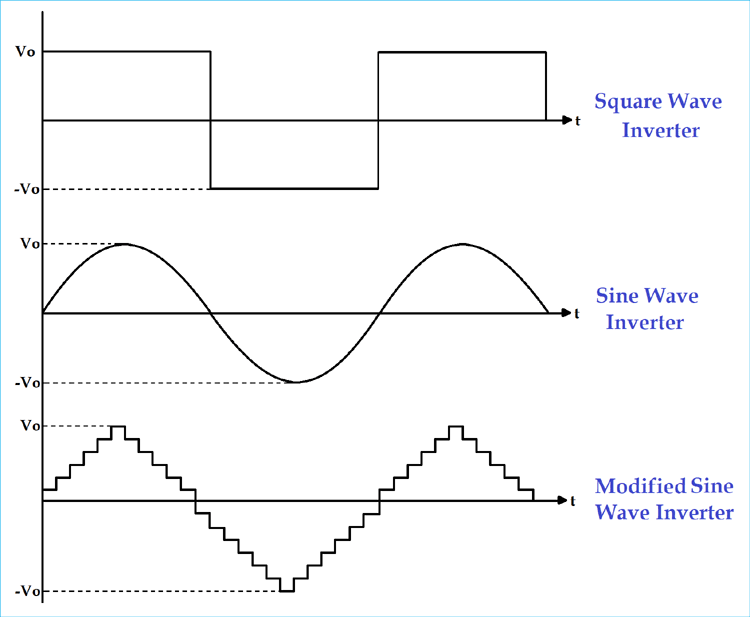
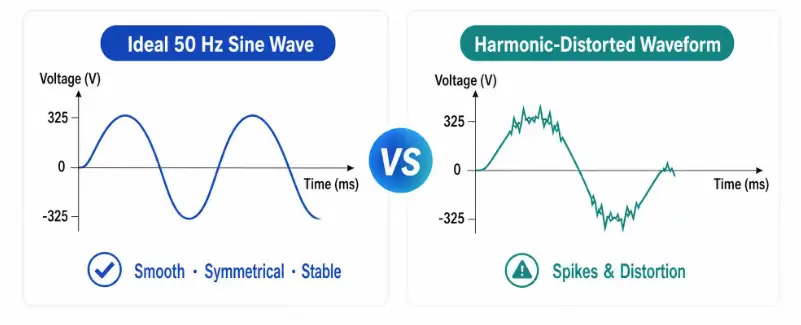
In a power grid, the ideal waveform is a smooth 50Hz sine wave. Non-linear devices—such as photovoltaic (PV) inverters and energy storage converters—distort this waveform. Harmonics are frequency components that are integer multiples of the fundamental frequency (i.e., “glitches” or distortions superimposed on the 50Hz sine wave);
they frequently occur in renewable energy power plants. Although invisible and intangible, they continuously impact equipment lifespan and power supply quality.
Common harmonics in renewable energy power plants
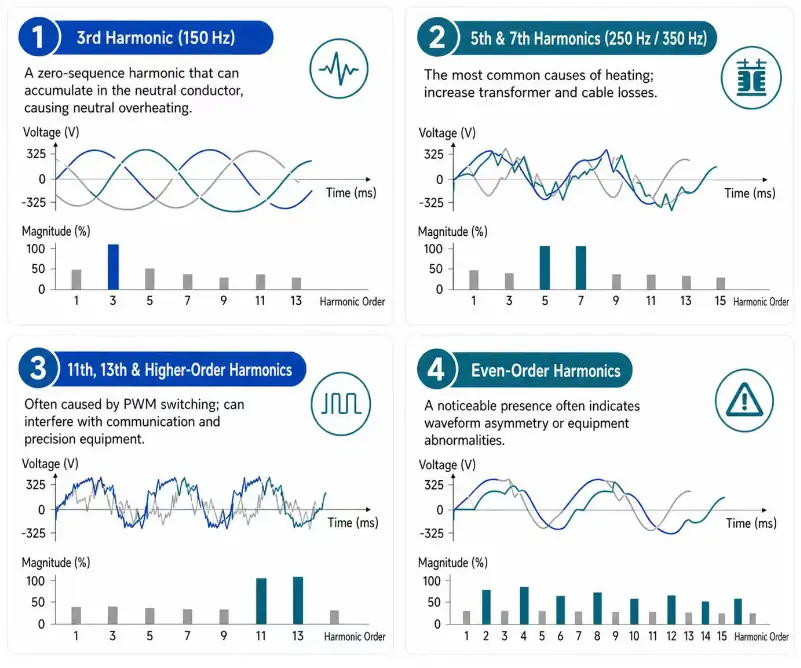
Odd-order harmonics are more common in renewable energy plants, particularly the 3rd, 5th, and 7th harmonics. The 3rd harmonic (150Hz) is a zero-sequence harmonic; it tends to accumulate on the neutral line, causing the line to overheat.
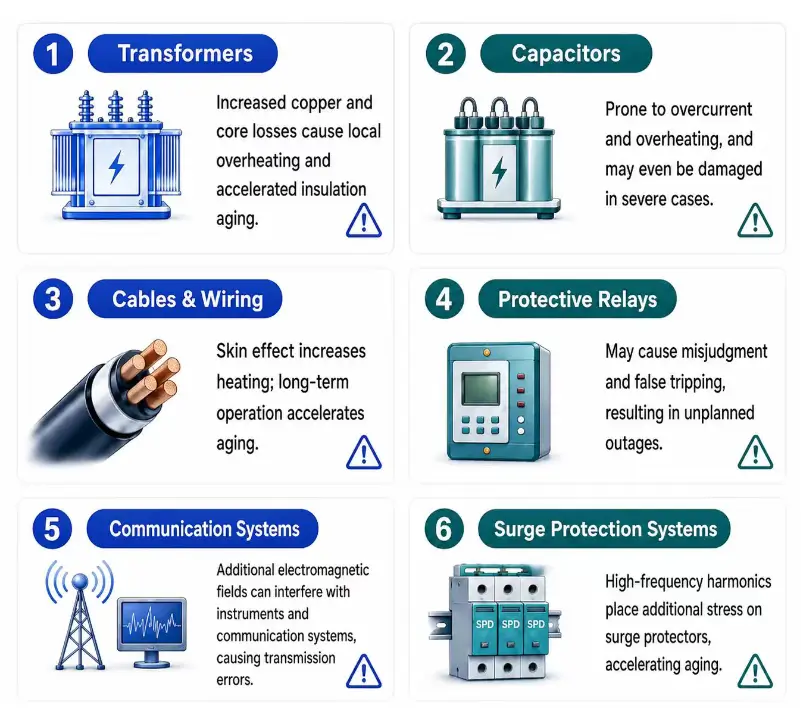
The 5th and 7th harmonics (250Hz/350Hz) are the most common culprits behind overheating, as they increase losses in transformers and cables.
The 11th, 13th, and higher-order harmonics are primarily caused by PWM switching and can easily interfere with communications and precision equipment.
The appearance of even-order harmonics often indicates waveform asymmetry or equipment malfunction.
How are harmonics generated?
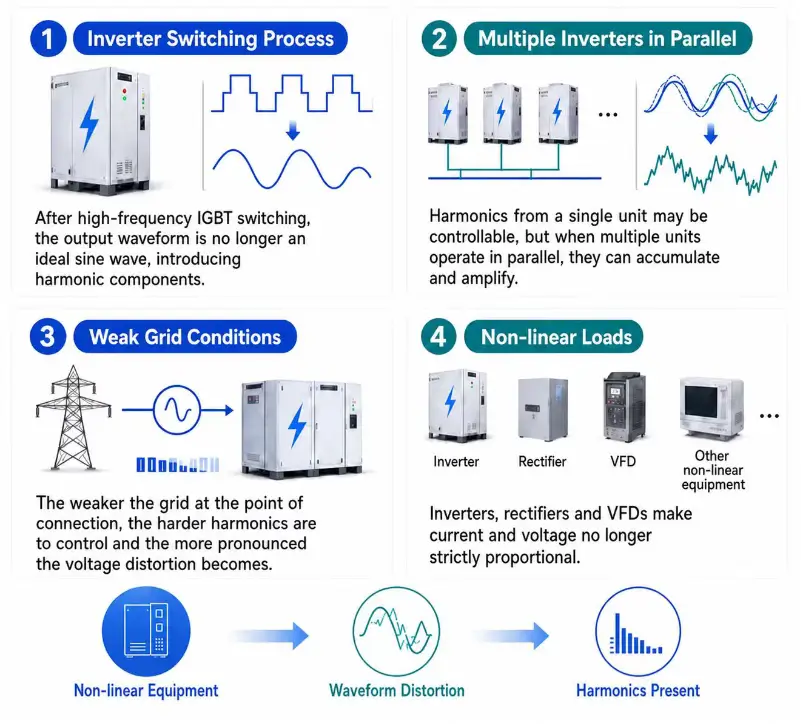
In power systems, the root cause of harmonics is non-linear loads. Harmonics in renewable energy plants essentially arise from the interaction between electronic equipment and grid conditions. During the inverter’s operation, high-frequency IGBT switching causes the output waveform to deviate from the ideal sine wave, introducing harmonic components. When multiple inverters operate in parallel, harmonics can superimpose and amplify, leading to uncontrollable levels.
Harmonics are harder to control in “weak” grid environments (e.g., where the grid connection point is weak), resulting in more pronounced voltage distortion. Non-linear devices—such as inverters, rectifiers, and variable frequency drives—cause current and voltage to lose their strictly proportional relationship.
How to control harmonics
Addressing harmonics requires monitoring and a combination of mitigation and optimization strategies. Mitigation can begin at the source by optimizing inverter control algorithms and PWM strategies to reduce harmonic injection. Remediation equipment—such as passive filters, APF, and SVG—can be installed to specifically address harmonic and reactive power issues.
Continuous monitoring is essential to track THD and individual harmonic levels in real time, enabling the timely detection of anomalies and the optimization of system operation.
Harmonic solutions offered by Sell-best
Sell-best offers online power quality monitoring meters from various brands capable of monitoring harmonics from the 2nd to the 63rd order. These devices support THD and voltage quality analysis and are suitable for deployment at grid connection points and critical nodes.