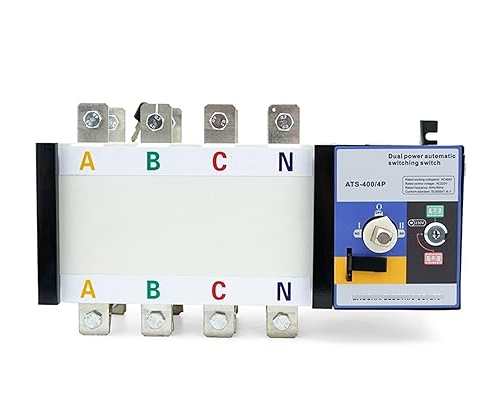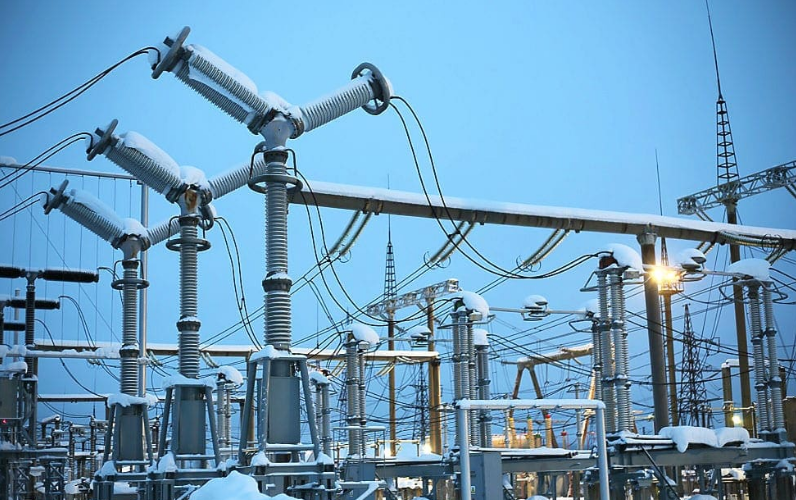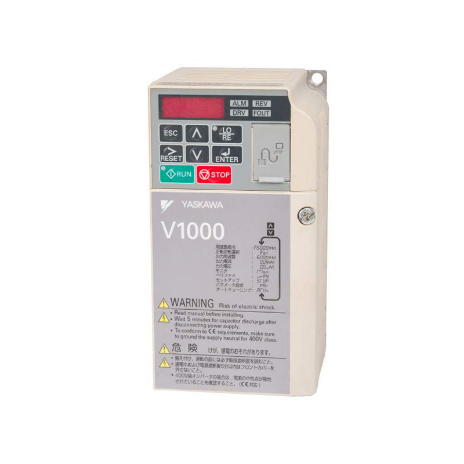
Two core pieces of equipment—situated at the end of the DC side and the start of the AC side, respectively—are the combiner box (DC/AC) and the inverter (centralized/string). This article focuses on the differences between combiner boxes and inverters.
Different Roles
In a complete photovoltaic (PV) system, PV modules generate direct current (DC), which is transmitted outward via MC4 connectors and DC cables. There are two primary pathways for converting this DC into alternating current (AC): Option 1 involves connecting PV strings to a DC combiner box, followed by transmission to a centralized inverter, where the DC is aggregated before undergoing centralized inversion.
Option 2 involves connecting PV strings directly to string inverters for conversion, followed by connection to an AC combiner box; this approach utilizes distributed inversion with centralized AC aggregation. This is currently the mainstream solution in the industry, although many projects omit the AC combiner box entirely, instead networking the string inverters directly.
PV Combiner Box Positioning
The DC combiner box serves as the collection, transfer, and protection unit on the DC side of a photovoltaic (PV) system. Its core function is to aggregate DC output from multiple PV strings and integrate DC protection components—such as DC fuses and surge protective devices (SPDs)—to facilitate circuit disconnection and provide overload and fault protection. This effectively prevents a fault in a single string from causing widespread power generation anomalies. It is a key device for simplifying DC wiring in large-scale PV installations.
The AC combiner box is installed on the AC output side of inverters and acts as a centralized AC collection unit. It aggregates the grid-frequency AC output from multiple string inverters and channels the combined power through an internal busbar. This setup simplifies grid-connection wiring, reduces AC cable usage, and lowers both line losses and construction costs. Standard internal components include AC molded-case circuit breakers (MCCBs), miniature circuit breakers (MCBs), and AC surge protective devices.
PV Inverter Positioning
Centralized inverters are the core energy conversion units for PV power plants, designed for the “PV strings → DC combiner box → centralized inverter” topology. They convert the aggregated high-voltage DC power from multiple strings into grid-frequency AC power. These units integrate features such as global MPPT tracking, self-diagnosis, multiple electrical protection mechanisms, and data communication capabilities. Characterized by high capacity, high integration, ease of O&M, and low cost, they are primarily suited for large-scale ground-mounted plants and large commercial/industrial centralized PV stations with uniform sunlight exposure and regular array layouts.
String inverters are the core conversion units for distributed PV systems, designed for the “PV strings → string inverter → AC combiner box” topology. They employ a mode of localized inversion per string followed by centralized AC collection. Equipped with independent string-level MPPT tracking, they precisely adapt to the operating conditions of individual strings, thereby minimizing power generation losses caused by shading or module aging. Featuring flexible equipment layout, high fault tolerance, and ease of installation and maintenance, the system is widely applicable to distributed photovoltaic power plants—such as residential, small-to-medium-sized commercial and industrial, and mountainous installations—characterized by uneven sunlight exposure and complex operating conditions.
Differences in Design Principles
Design principles of the AC/DC combiner box:
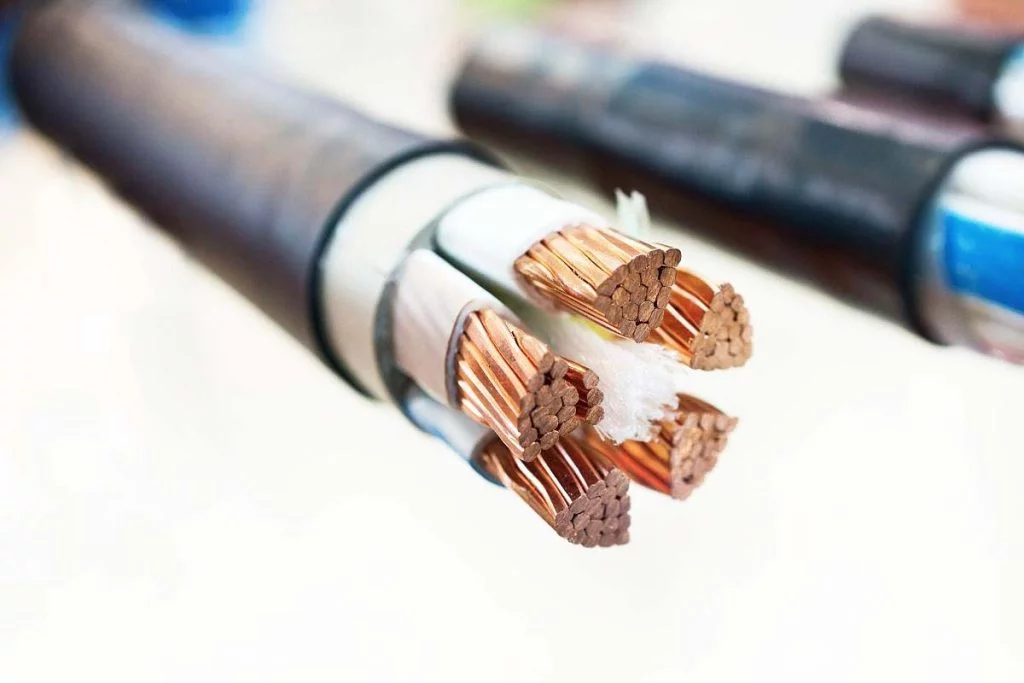
DC combiner boxes typically come in configurations of 4, 6, 8, 12, or 16 input channels, with mainstream input voltages of DC 1000V or 1500V. The number of channels must be matched to the number of module strings at the site; a higher number of channels means a wider impact range should a single channel fail. Cable selection is based on calculations involving string short-circuit current and voltage drop, and the enclosure typically requires an IP65 protection rating for outdoor projects. For small-scale commercial, industrial, or rooftop distributed PV projects, strings are often connected directly to the inverter, eliminating the need for a DC combiner box; however, large-scale ground-mounted power plants—where multiple strings converge—utilize DC combiner boxes to simplify wiring.
AC combiner boxes support customized channel configurations, with the number of channels determined by the quantity and capacity of the inverters. In mainstream string inverter setups, multiple inverters can connect directly at the low-voltage side of the box-type transformer; consequently, standalone AC combiner boxes are often simplified or eliminated entirely. They remain in use primarily for large-scale projects or scenarios with dispersed grid-connection points, where they are installed downstream of the inverters to aggregate the AC output from multiple units.
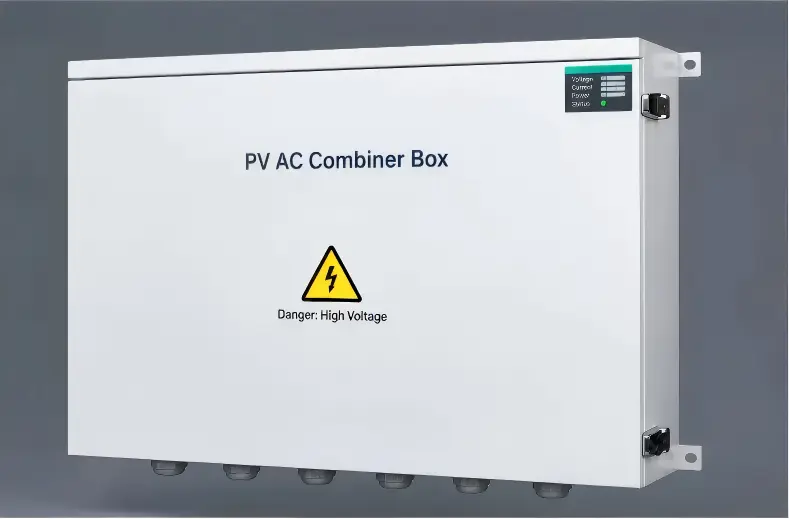
AC vs. DC Combiner Box
| Comparison Item | DC Combiner Box | AC Combiner Box |
| Installation Location | Located upstream of the inverter’s DC side | Downstream of the inverter’s AC side |
| Aggregation Target | Handles DC input from multiple PV strings | AC output from multiple inverters |
| Core Components | Equipped with DC fuses and DC surge protective devices (SPDs) | AC molded-case circuit breakers, miniature circuit breakers, AC surge protective devices (SPDs) |
| Current Trends | Widely used in large-scale ground-mounted power plants | Largely simplified or eliminated; retained only for large-scale projects and distributed grid-connection points |
| Design Focus | Requires matching the number of strings and verifying DC cable voltage drop | Configuration of input circuits; verification of AC short-circuit current |
PV Inverter Design Principles
Centralized inverters typically feature only 1 to 4 MPPT channels; connected PV strings must share consistent orientation, tilt angles, and shading conditions to avoid significant mismatch losses. With capacities ranging from 500 kW to 1 MW, they are designed for the centralized topology of large-scale ground-mounted power plants. They accept inputs from DC combiner boxes and output low- or medium-voltage AC, making them suitable for large-scale ground-mounted and commercial/industrial plants characterized by uniform sunlight exposure and orderly array layouts.
String inverters are currently the industry’s mainstream product. Their MPPT channel count can match the number of PV strings; to minimize energy yield losses, strings with different orientations or shading conditions are not connected to the same MPPT. Mainstream high-power models range from 150 kW to 320 kW, while lower-power models are often selected for distributed rooftop systems. They allow for direct connection of PV strings to the DC side, offering broader application versatility; specialized models—featuring enhanced corrosion resistance, heat dissipation, and altitude-adjusted derating capabilities—are available for challenging environments such as deserts, water surfaces, highly corrosive mountainous areas, and high-altitude regions.
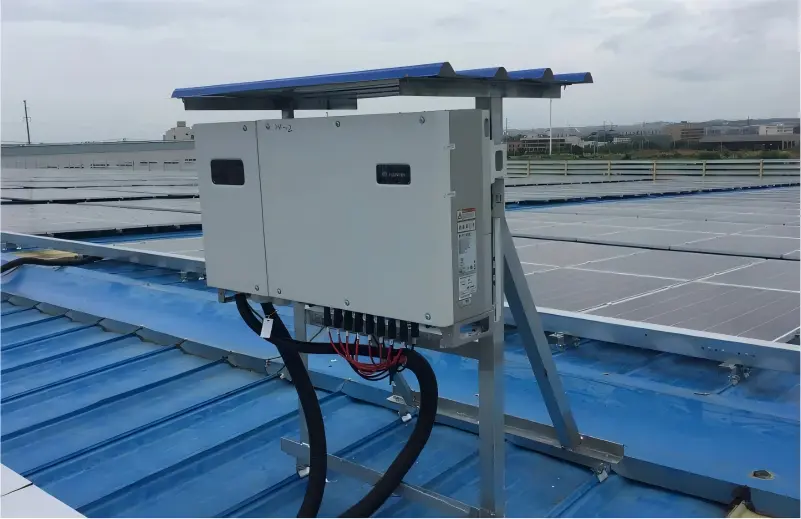
Centralized vs. String Inverters
| Comparison Item | Centralized Inverter | String Inverters (Mainstream) |
| Topology | PV strings → DC combiner box → Centralized inverter | PV Strings → String Inverter → AC Combiner Box |
| MPPT | 1–4 inputs; array-level MPPT | String-level MPPT for precise matching |
| Capacity | 500 kW – 1 MW class | Mainstream power range: 150 kW – 320 kW |
| Fault Tolerance | High impact of single-point failure | Minimal impact from a single-string fault |
| Application Scenario | Suitable for large-scale ground-mounted plants with uniform irradiance and regular layout | Suitable for residential, small-to-medium C&I, and complex distributed scenarios (e.g., mountainous terrain) |
| Design Focus | Requires string consistency and DC-side short-circuit verification | MPPT matching; AC-side cable voltage drop considerations |
Conclusion
Selecting the right PV system configuration depends on plant capacity, array layout, shading conditions, and grid-connection requirements. DC combiner boxes simplify string collection and protection before centralized inversion, while AC combiner boxes aggregate inverter outputs where required. Centralized inverters are well suited to large-scale PV plants with consistent array conditions, whereas string inverters offer greater MPPT flexibility and improved adaptability to complex installations. Understanding the roles of these components helps system designers and installers optimize system architecture, simplify wiring, and improve overall operational efficiency.