Arc flash protection and bus differential protection (often referred to as “bus differential protection”) constitute two of the core components within the safety protection framework for power system busbars. Among them, bus differential protection—serving as the traditional primary protection for busbars within the power grid—has been utilized for decades and stands as a critical safeguard for ensuring the stability of the grid system. Conversely, arc flash protection has gained rapid popularity in recent years due to its outstanding advantage of ultra-high-speed operation (acting within milliseconds), establishing itself as a key piece of equipment for safeguarding both equipment integrity and personnel safety. Although both fall under the general category of busbar protection, they feature distinct roles and specific areas of focus; however, industry practitioners frequently confuse the two during the engineering selection and application processes. Based on international IEC standards, this article provides a comprehensive analysis of the fundamental differences between these two protection systems.
Working Principles of Arc Flash Protection and Bus Differential Protection
Working Principle of Bus Differential Protection
In accordance with the IEC 60255 standard, bus differential protection serves as the statutory primary protection for high-voltage busbars within power systems. Its core mission is to ensure the stability of the power grid and prevent busbar faults from escalating. Its operational principle is based on the current differential method: by comparing the vector sum of currents flowing into and out of all branches connected to the busbar, the system identifies a busbar fault when the current differential exceeds a preset threshold. Upon detection, it rapidly trips all circuit breakers within the faulted zone to isolate the fault point, thereby preventing the fault from propagating upstream into the wider power grid and ensuring the stability of the entire grid’s power supply.
Working Principle of Arc Flash Protection
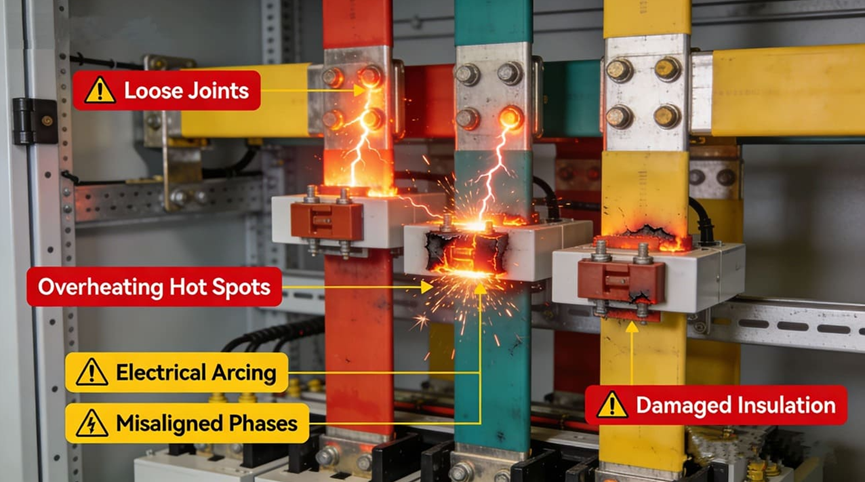
In accordance with the IEC 62271-200 standard, arc flash protection is a rapid-response protection device specifically designed to address internal arc faults within switchgear assemblies. Its core mission is to limit arc energy and safeguard both equipment integrity and personnel safety. Its operational principle relies primarily on the detection of arc light signals as the main criterion, supplemented by fault current detection as an auxiliary criterion, utilizing a dual-criterion interlocking trigger mechanism. When an internal arc fault occurs within the switchgear, arc light sensors capture the light signal within milliseconds; once this signal is corroborated by the corresponding current signal to confirm the fault, the system rapidly triggers a trip command to interrupt the faulted circuit. This action prevents the extreme heat and high-pressure shockwaves generated by the arc from destroying equipment, triggering explosions, or causing personnel casualties.
Differences Between Arc Flash Protection and Bus Differential Protection
| Comparison Dimension | Arc Flash Protection | Busbar Differential Protection |
| Core Positioning | Protect equipment and personal safety, extinguish arcs quickly | Ensure power grid system stability, isolate faults |
| Operating Speed | Extremely fast (< 1~7 ms) | Relatively slow (20~45 ms) |
| Fault Identification Method | Arc light signal as primary, current signal as auxiliary | Based on current differential principle, compares incoming/outgoing current differences |
| Fault Coverage | Mainly covers internal arc faults in cabinets, with sensor blind spots | Fully covers all types of busbar faults, no blind spots |
| Selectivity (Tripping Range) | Selective tripping, only isolates the faulty area | Usually trips all circuit breakers in the same busbar section |
| Anti-interference Capability | Fiber-optic transmission, extremely high anti-electromagnetic interference capability | Relies on CT sampling, susceptible to electromagnetic interference and CT saturation |
| Engineering Retrofit Compatibility | Easy to install, no modification to existing wiring required, low cost | High retrofit difficulty, requires dedicated CT installation, high cost |
| Standard Positioning | Fast internal arc protection, not a legally required main protection | Legally required main protection for high-voltage busbars, participates in grid-wide relay coordination |
Can Arc Flash Protection Replace Bus Differential Protection?
Based on a combination of IEC standard requirements and practical engineering experience, the conclusion is clear: Arc flash protection cannot completely replace bus differential protection. However, in specific scenarios, it can serve as a simplified or alternative solution. The relationship between the two is one of “complementary synergy,” rather than “adversarial substitution.”
For high-voltage busbars rated at 110 kV and above, arc flash protection absolutely cannot replace bus differential protection. There are three core reasons for this:
First, bus differential protection is a statutory primary protection scheme explicitly mandated by both IEC standards and national standards; it bears the critical responsibilities of system-wide relay coordination, fault isolation, and system stability. Arc flash protection cannot participate in system-wide dispatch coordination settings; if used in isolation, it would compromise the selectivity of the relay protection system, potentially triggering mal-trips (unwanted tripping of healthy circuits) and leading to widespread power outages.
Second, arc flash protection relies on the detection of arc light; consequently, it suffers from “blind spots” where faults may go undetected, meaning it cannot cover all possible busbar faults. This presents a risk of protection failure (failure to operate) and fails to meet the requirements for reliable, comprehensive fault protection of high-voltage busbars.
Third, faults on high-voltage busbars frequently result in Current Transformer (CT) saturation. Bus differential protection incorporates built-in saturation restraint algorithms to handle this, whereas arc flash protection lacks this capability. As a result, it cannot effectively adapt to complex fault conditions and would fail to pass the grid connection acceptance tests and dispatch filing requirements mandated by power grid authorities.
The optimal configuration in this scenario is a synergistic “dual protection” system comprising both bus differential protection and arc flash protection: Bus differential protection serves as the primary protection, responsible for isolating faults and ensuring system stability; arc flash protection serves as an auxiliary backup protection, acting within milliseconds—before the bus differential protection operates—to rapidly extinguish the arc, thereby minimizing equipment damage and mitigating safety risks to personnel. This creates a dual-layer protection system characterized by both “stability” (system integrity) and “speed” (rapid fault clearance).
According to relevant IEC standards, in medium-to-low voltage scenarios (35 kV and below), projects involving the retrofitting of aging switchgear, low-voltage 400 V applications, and DC busbars for energy storage systems, arc flash protection can be utilized independently as the primary busbar protection, thereby replacing traditional bus differential protection:
1. 10kV/6kV Plant Auxiliary and Medium/Low-Voltage Distribution Busbars: Medium-to-low-voltage busbars generally have relatively lower requirements regarding grid stability. Implementing busbar differential protection for these systems entails high configuration costs and significant retrofitting difficulties. In contrast, arc flash protection features simple wiring, low cost, and can be directly retrofitted; moreover, it fully satisfies the safety protection needs of medium-to-low-voltage busbars. This approach complies with national standards, which stipulate that “for switchgear rated at 35kV and below that is not equipped with busbar differential protection, arc flash protection may be configured independently to serve as the primary busbar protection.”
2. Retrofit Projects for Aging Switchgear: Retrofitting aging switchgear with busbar differential protection requires the installation of dedicated Current Transformers (CTs). This not only incurs high costs but is also constrained by limited internal cabinet space, resulting in extended retrofit cycles. Conversely, arc flash protection requires no modification to existing wiring and can be installed rapidly, effectively resolving the long-standing issue of aging medium-to-low-voltage switchgear lacking dedicated busbar protection.
3. Low-Voltage 400V and Energy Storage DC Busbars: Low-voltage distribution systems currently lack mature solutions for busbar differential protection, while energy storage DC busbars are incompatible with AC-based differential protection logic. Arc flash protection currently represents the optimal method for safeguarding against DC and low-voltage arc faults. It can comprehensively replace traditional backup overcurrent protection, thereby achieving safety protection that is both low-cost and highly reliable.
Summary
The core objective of busbar differential protection is “system preservation”—ensuring the overall stable operation of the power grid. The core objective of arc flash protection is “safety assurance”—rapidly suppressing arc faults to safeguard both equipment and personnel. These two protection methods have distinct roles yet are mutually complementary; in the context of safety protection for modern power systems and energy storage power stations, neither can be dispensed with. Only through appropriate selection and configuration can the dual objectives of system stability and safety assurance be successfully realized.