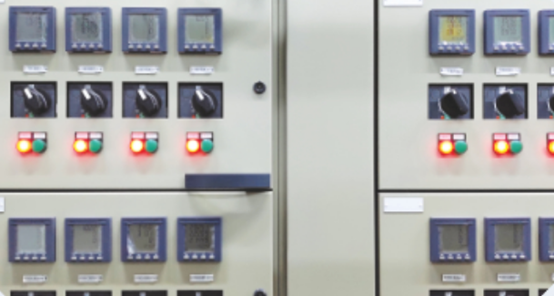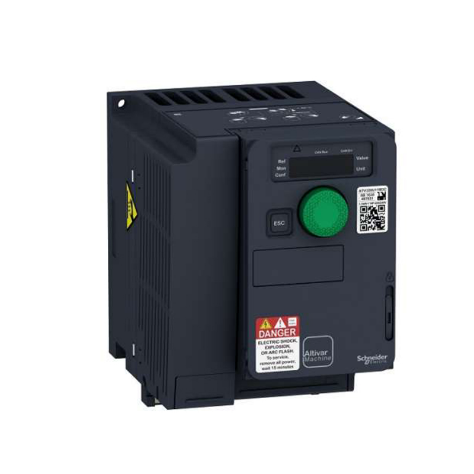
Disconnect switches and circuit breakers are crucial components of ring main units (RMS). Within a RMS, a disconnect switch can also be called a load break switch, and a disconnect switch with a fuse function similarly to a circuit breaker. However, there are subtle differences between the two.
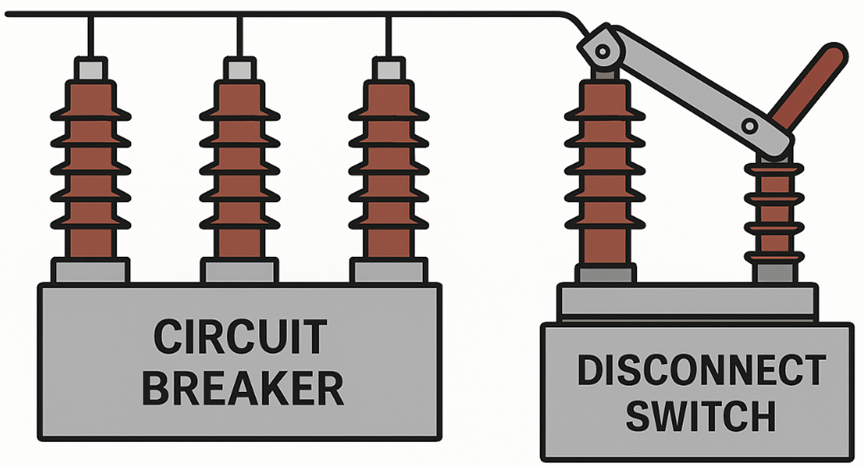
What is RMU disconnect switch
A disconnect switch (commonly referred to as a load break switch in RMUs) is a mechanical switching device designed to:
- Make, carry, and break rated current under normal operating conditions
- Provide visible isolation for maintenance safety
- In three-position designs:
- Closed (ON)
- Open (OFF)
- Earth (Grounded)
However, it cannot interrupt short-circuit current. If short-circuit protection is required, it is typically combined with a fuse (switch-fuse combination).
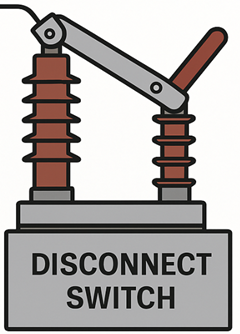
What is RMU circuit breaker?
A circuit breaker is a protective switching device capable of:
- Making, carrying, and breaking rated current
- Interrupting short-circuit current
- Providing automatic fault protection
In RMUs, the circuit breaker is typically integrated with a protection relay system. A current transformer (CT) detects fault current, and when abnormal current is identified, the relay energizes the trip coil, causing rapid opening of the breaker contacts.
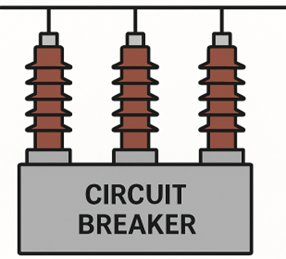
Difference between disconnect switch and circuit breaker
1. The main difference lies in the interruption of rated current or fault current: Disconnect switches can interrupt rated current, but not short-circuit current.
Circuit breakers can interrupt any type of current, whether rated or abnormal. Both have short-time current withstand capability, meaning they can withstand a fault current for 1 or 3 seconds when a current fault occurs. However, only circuit breakers have short-time current interruption capability.
2. The symbols representing disconnect switches and circuit breakers are different: Disconnect switches have a small circle on top, while circuit breakers are symbolized by a cross.
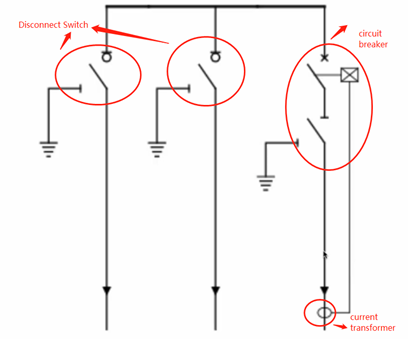
3. Rating voltage differs: Disconnect switches are up to and including 52kV; circuit breakers are up to and including 800kV.
4. Different IEC standards: Disconnect switches use the standard IEC 62271-103, while circuit breakers use the standard IEC 62271-100.
Conclusion
Although disconnect switches and circuit breakers may appear similar within RMU assemblies, they serve distinct technical roles.
A switch-disconnector primarily provides operational switching and isolation, whereas a circuit breaker ensures system protection through fault interruption capability.