Power transformers are core components of the power grid, and their operational status directly impacts the reliability of power supply. Because transformers are subjected to high voltages and currents, as well as thermal, electrical, and mechanical stresses over long periods, their internal insulation systems gradually age, potentially leading to partial discharge (PD). Consequently, an increasing number of power utilities are adopting online PD monitoring systems; by capturing discharge signals in real-time, these systems provide early warnings regarding equipment health. This article introduces transformer PD monitoring systems from various perspectives.
What is a transformer online partial discharge monitoring device?
An online partial discharge monitoring system for transformer is a condition-monitoring unit installed on an active transformer. It uses sensors to continuously capture signals—such as electrical impulses, ultra-high frequency (UHF) signals, electromagnetic waves, and ultrasonic waves—generated by partial discharge, and employs analysis software to assess the health of the insulation system.
Why is online partial discharge monitoring necessary?
Traditional insulation testing methods—such as AC withstand voltage tests, PD tests, dissolved gas analysis (DGA), and insulation resistance tests—require power outages. These methods involve long testing cycles and cannot monitor operating conditions in real-time, making it difficult to detect sudden insulation issues promptly.
In contrast, online PD monitoring systems continuously collect PD data. By analyzing changes in discharge amplitude, frequency, and Phase-Resolved Partial Discharge (PRPD) patterns, they enable the early detection of insulation defects and the scheduling of maintenance. This helps prevent insulation breakdown—which could otherwise lead to power outages, equipment destruction, and high repair costs—and facilitates a shift in operations and maintenance (O&M) from reactive repair to condition-based maintenance. Furthermore, these systems align with the development trends of smart substations, digital O&M, and full-lifecycle equipment management, serving as a crucial component of the intelligent sensing architecture for large-scale power equipment.
What are the primary detection methods for transformer online partial discharge monitoring?
There are currently four common methods for detecting partial discharge in transformers within the industry. Each has distinct technical characteristics, application scenarios, and installation requirements, as detailed below:
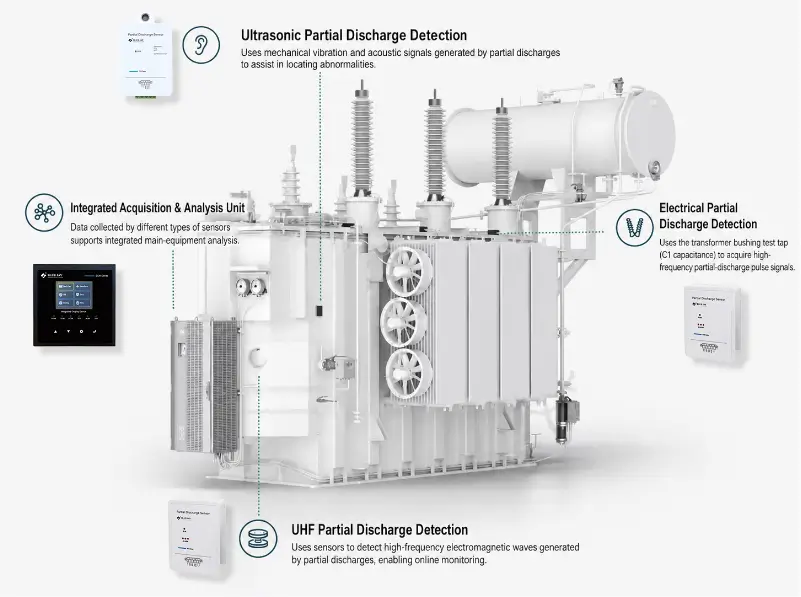
1. UHF (Ultra-High Frequency) Partial Discharge Detection
UHF partial discharge detection is one of the methods commonly used for large power transformers. Partial discharge generates high-frequency electromagnetic waves; UHF sensors installed on the transformer tank capture these waves, thereby enabling PD detection. The core feature of this technology is its strong resistance to external interference, making it suitable for online operational monitoring and capable of discharge localization and analysis.
According to overseas technical data, UHF sensors primarily detect electromagnetic radiation in the 300 MHz to 3000 MHz range generated by partial discharge, while leveraging the shielding structure of the transformer tank to further suppress external interference. There are two common installation methods: window-type UHF sensors (mounted on an opening in the tank) and drain-valve-mounted UHF sensors; UHF detection windows can be designed into new transformers, while existing equipment can be retrofitted.
2. HFCT (High-Frequency Current Transformer) Detection
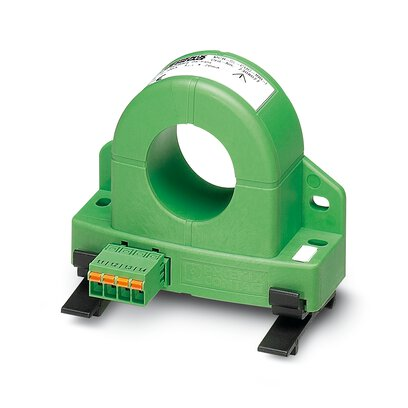
The core principle of HFCT detection involves using an HFCT sensor to detect high-frequency pulse signals in the grounding wire, thereby identifying partial discharge. This method is characterized by non-intrusive installation, ease of retrofitting, and high sensitivity, requiring no major modifications to the equipment itself.
Sensors are typically installed on transformer grounding wires, cable shielding layers, or grounding circuits; this makes the method particularly suitable for retrofitting older transformers and upgrading them for online monitoring, as it quickly adapts to the monitoring needs of existing equipment.
3. Ultrasonic Partial Discharge Detection
Partial discharge is accompanied by mechanical vibrations and ultrasonic signals. Ultrasonic detection exploits this characteristic by using ultrasonic sensors mounted on the transformer tank to capture these signals. The primary function of this method is to determine whether discharge is occurring and to assist in locating areas of abnormal discharge.
Its key advantages include simple installation that does not disrupt normal equipment operation; it is suitable for both routine inspections and as a supplementary online monitoring tool, working in conjunction with other methods to enhance monitoring accuracy.
- TEV (Transient Earth Voltage) Detection
TEV detection is primarily applied to metal-enclosed equipment. Its principle relies on the fact that high-frequency currents generated by partial discharge propagate along the metal enclosure, creating transient voltage signals; capturing these signals allows for the detection of partial discharge issues. This method is suited for specific applications—mainly metal-enclosed equipment such as switchgear, ring main units (RMUs), and transformer cable boxes—enabling targeted monitoring of partial discharge status and ensuring operational safety.
Key Applications of Transformer Partial Discharge Online Monitoring
Transformer partial discharge online monitoring technology has been widely deployed across key sectors—including power grids, industrial enterprises, and new energy facilities—delivering tailored monitoring and protection based on specific operational requirements. The specific application scenarios are as follows:
1. Power Grid Substations
In power grid substations, PD online monitoring devices are primarily used to monitor the insulation status of main transformers in real time. By continuously collecting PD data, these devices enable dynamic analysis of transformer operating trends. Furthermore, they can issue timely fault warnings based on data anomalies, helping operations and maintenance personnel identify insulation degradation trends early, mitigate the risk of sudden failures, ensure the stable operation of critical grid equipment, and support safe, reliable power supply.
2.Industrial Enterprise Substations
Industrial enterprise substations represent a vital application scenario for PD online monitoring, offering particular value to continuous-production enterprises such as those in the steel and petrochemical industries. These enterprises rely on continuous production processes; an unexpected transformer shutdown would directly halt production and result in significant economic losses. Deploying PD online monitoring devices allows for real-time tracking of transformer insulation status, early detection of potential faults, and the prevention of unplanned outages, thereby ensuring the continuity and stability of industrial production.
3.New Energy Facilities
With the rapid growth of new energy sectors—including wind power, photovoltaics, and energy storage—the operational reliability of step-up transformers at new energy facilities has become a major industry focus. As core equipment for power transmission, the stable operation of these step-up transformers directly impacts grid-connection efficiency and power supply quality. PD online monitoring devices provide round-the-clock insulation monitoring for these transformers, enabling the timely detection of PD anomalies and providing the data needed for equipment maintenance, ultimately ensuring the safe and efficient operation of new energy facilities.
How do you choose a manufacturer for transformer partial discharge (PD) online monitoring devices?
When selecting a manufacturer for transformer PD online monitoring devices, we recommend focusing on the following aspects:
1. Do they possess multiple types of PD detection technologies?
Mature transformer PD monitoring solutions typically do not rely on a single sensor type; instead, they utilize a combination of technologies tailored to the specific equipment conditions.
| Detection Methods | Primary signals captured | Applicable Scenarios |
| UHF (Ultra-High Frequency) | Electromagnetic waves generated by partial discharge | Large power transformers, new projects |
| HFCT (High-Frequency Current Transformer) | High-frequency pulses in the grounding circuit | Retrofit projects, online upgrades |
| Ultrasonic | Mechanical vibration signals | Assisted positioning, on-site diagnostics |
| TEV (Transient Earth Voltage) | Signals propagating through the equipment enclosure | Switchgear cabinets, cable boxes |
Therefore, a capable PD monitoring manufacturer should possess: sensor R&D capabilities, signal acquisition technology, data analysis algorithms, and system integration capabilities.
2. Does it support online operation without interrupting the power supply?
Transformers are critical power assets, and offline testing during power outages can disrupt production. An excellent PD online monitoring system should offer: live installation or upgrades without power interruption, stable long-term operation, remote data access, and automatic anomaly alarms. For example, existing transformers lacking dedicated UHF detection windows can be retrofitted using external sensors or ground loop detection methods.
3. Does it possess PRPD analysis capabilities?
Assessing PD involves more than just looking at discharge amplitude. Online PD systems typically evaluate the equipment’s insulation status over the long term using trend analysis and Phase-Resolved Partial Discharge (PRPD) patterns.
4. Does it support integration with digital platforms?
With the development of smart substations, PD data needs to be uploaded to backend platforms rather than just viewed on-site. Mature systems typically support: web-based platforms, SCADA systems, IEC 61850 communication, and remote diagnostics.
5. Can the PD online monitoring system provide real-time alarms?
Real-time alarm capabilities offer greater convenience. The monitoring system can trigger anomaly alarms based on discharge amplitude, trends, and preset thresholds, while also supporting remote monitoring.