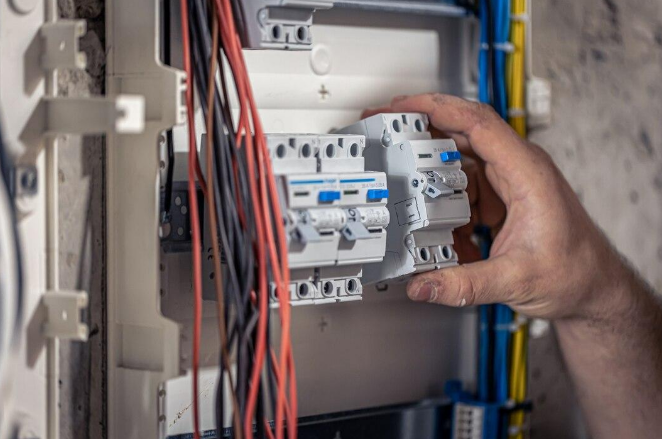
An electrical panel, also known as a distribution panel or switchboard depending on its design and application, is a central part of a low-voltage power distribution system. It receives electrical power, distributes it to outgoing circuits, and integrates protection, control, and monitoring functions to support safe and reliable operation.
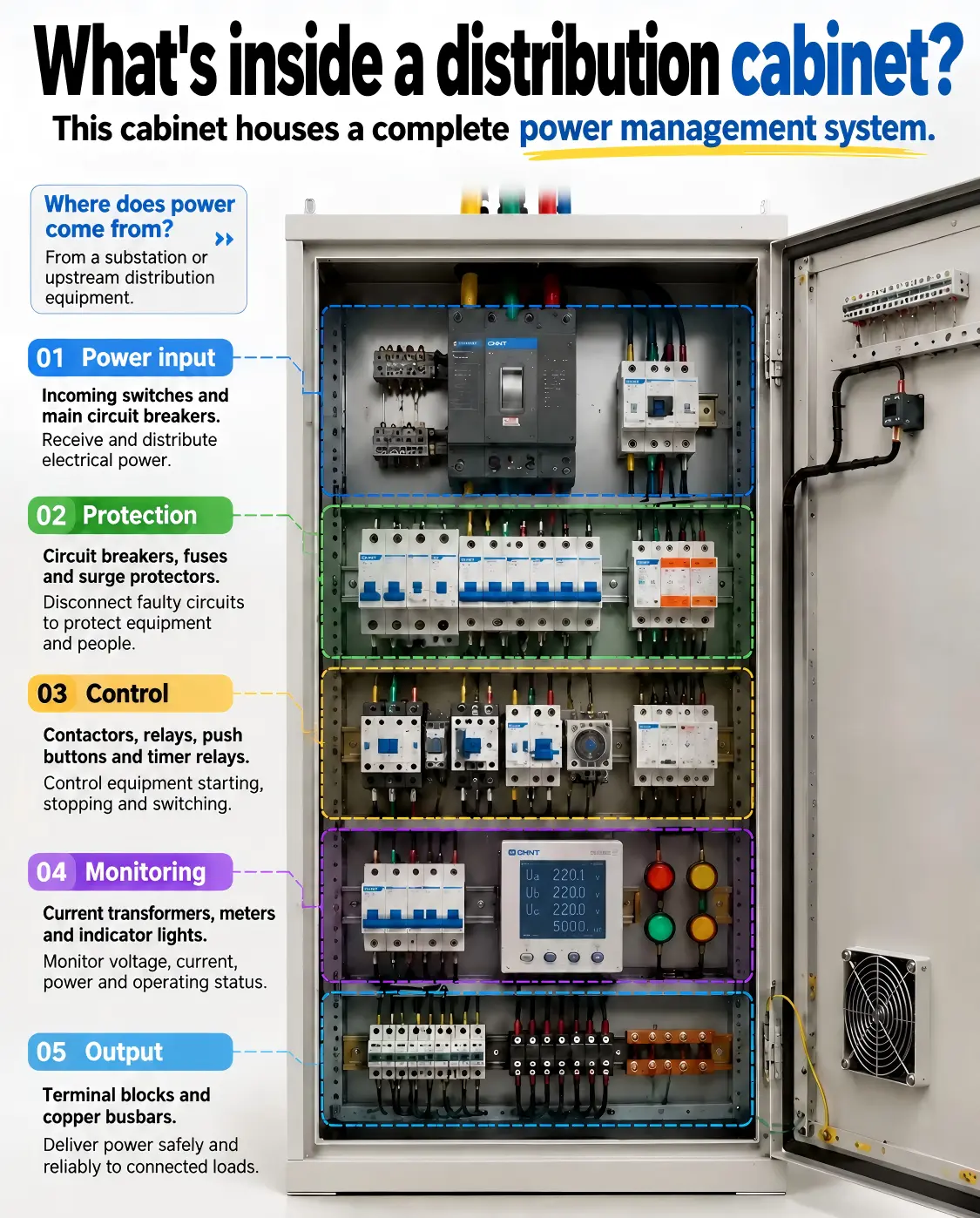
Although the internal layout varies according to system design, rated capacity, and application, the main components can be understood through five functional groups: power input, circuit protection, control, monitoring, and power distribution output.
Five Main Functional Groups of Electrical Panel Components
1. Power Input Section
The power input section serves as the entry point for electrical power entering the panel. Its main components typically include an incoming circuit breaker or switch-disconnector, incoming terminals, and, where required, busbar connections.
The incoming circuit breaker provides switching and, where designed for that purpose, overcurrent protection for the incoming supply. It also allows the panel to be isolated or disconnected according to the system’s operating and safety requirements. The incoming arrangement must be selected based on the supply characteristics, rated current, prospective short-circuit current, and applicable electrical standards.
2. Circuit Protection Section
The protection section contains devices designed to protect circuits and connected equipment against electrical faults. Common components include miniature circuit breakers (MCBs), molded-case circuit breakers (MCCBs), fuses, residual current devices (RCDs), and surge protective devices (SPDs), depending on the application.
Circuit breakers and fuses provide overcurrent protection against overloads and short circuits when correctly rated and coordinated. RCDs detect residual current and help protect against electric shock or earth-leakage hazards, depending on the device type and installation. SPDs limit transient overvoltages caused by events such as lightning or switching operations. These devices serve different protective functions and must be selected according to the system’s protection requirements.
3. Control Section
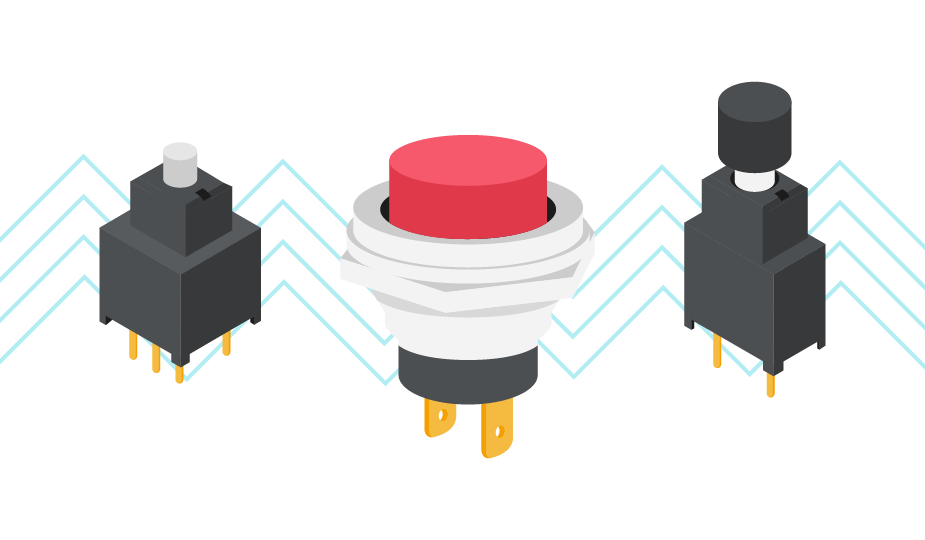
The control section manages the switching and operation of electrical equipment. Typical components include contactors, control relays, time-delay relays, auxiliary contacts, and control circuit devices.
These components enable functions such as motor starting and stopping, automatic switching, interlocking, and sequence control. In automated installations, control circuits may also interface with programmable logic controllers (PLCs), building management systems, or other supervisory systems. Proper coordination between control and protection devices helps ensure reliable operation and appropriate responses to abnormal conditions.
4. Electrical Monitoring Section
The monitoring section provides information about the panel’s electrical parameters and operating status. Common components include multifunction power meters, current transformers (CTs), voltage transformers where required, status indicators, and communication interfaces.
Power meters can measure parameters such as voltage, current, active power, power factor, frequency, and energy consumption, depending on their capabilities and wiring configuration. CTs provide scaled current signals for measurement and protection devices. Indicator lamps and digital displays show operating conditions, while communication interfaces such as RS-485 or Ethernet can transmit data to an energy management or supervisory system.
These monitoring functions help operators assess system performance, identify abnormal conditions, and improve energy management.
5. Power Distribution Output Section
The output section distributes power from the panel to downstream circuits and loads. Typical components include outgoing circuit breakers or fuses, distribution busbars, terminal blocks, and outgoing cables.
Each outgoing circuit should have protection appropriate to its cable rating, load characteristics, and fault conditions. Busbars and terminals must be rated for the required current and short-circuit withstand conditions, while cable connections must be properly sized and secured. Depending on the installation, ventilation fans or other thermal management components may be provided to control internal temperature and maintain suitable operating conditions.
Conclusion
Electrical panel components work together to distribute power, protect circuits, control equipment, and monitor electrical conditions. Understanding the function of each group helps engineers and panel builders select compatible components, improve system reliability, and simplify operation and maintenance. The final configuration should always be based on the application’s electrical requirements, protection coordination, and applicable standards.