Both the Capdis voltage indicator and Blue Jay voltage indicator are engineered to detect loss of voltage in 1–52 kV medium-voltage distribution networks. This article compares the differences between the two solutions, helping you evaluate their performance to boost personnel safety and grid reliability.
Capdis Voltage indicator vs Blue Jay Voltage Indicator
Product Types
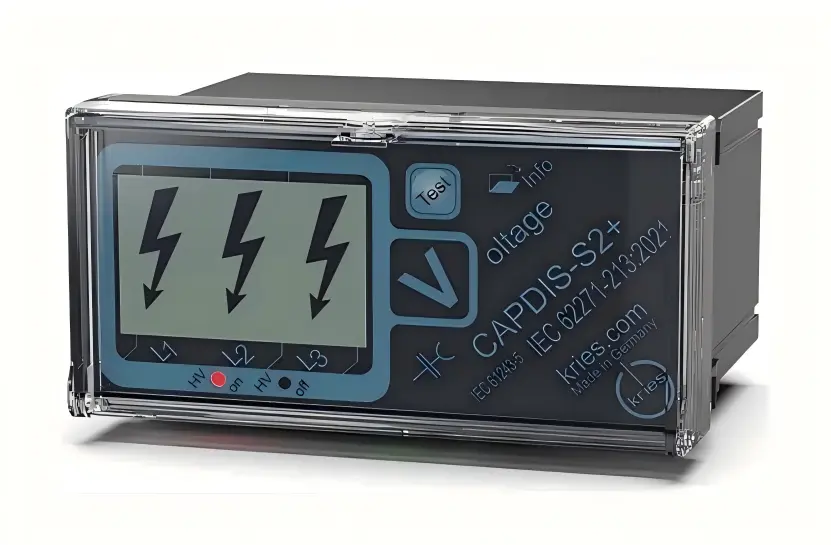
- Kries CAPDIS Voltage Detecting Systems
Kries offers a range of capacitive voltage detecting systems, including CAPDIS-S1+ and CAPDIS-S2+ for medium-voltage applications. Depending on the model, functions include three-phase voltage indication, self-testing, capacitive divider monitoring, relay signaling, and interfaces for phase comparison. Selected CAPDIS models also integrate partial discharge detection.
- Blue Jay Voltage Indicators
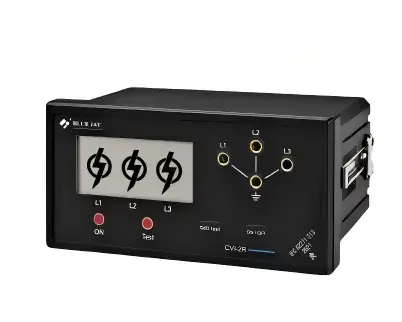
Blue Jay offers two main product families: the CVI-2R Voltage Detecting and Indicating System and the CVI Series Voltage Presence Indicating System. The CVI-2R features LCD voltage status indication, self-test, phase-sequence verification, capacitive adaptation, and two relay outputs.
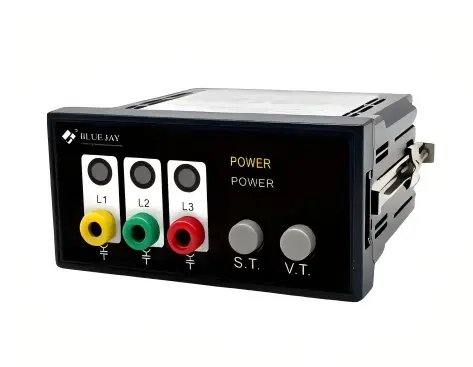
The CVI Series offers LED indication in externally powered and self-powered versions, with self-test and interlocking relay outputs available on selected models.
Technical Specifications
The following table compares representative models with published specifications. Values should not be generalized to every model in either product family.
| Specification | CAPDIS S1+ R4.5 | CAPDIS S2+ R4.5 | Blue Jay CVI-2R | Blue Jay CVI Series |
| Product type | VDIS | VDIS | VDIS | VPIS |
| Rated voltage range | 1–52 kV | 1–52 kV | 1–35 kV | 7.2–40.5 kV |
| Display | LCD | LCD and status LEDs | LCD and LED indicators | LED |
| Auxiliary power | Not required | 24–230 V AC/DC for relay operation | 85–265 V AC/DC | External supply or self-powered, depending on model |
| Relay outputs | / | 2 changeover signal relays | 2 relay outputs | Available on EPR and SPR models |
| Self-test | Yes | Yes | Yes | Available on selected models |
| Phase comparison interface | Three-phase LRM | Three-phase LRM | Three-phase LRM | Three-phase LRM |
| Capacitive adaptation | Adjustable capacitor switching module | Adjustable capacitor switching module | 200 / 125 / 80 / 45 pF Adjustable | 150 / 115 / 80 / 45 pF Adjustable |
| Standards | IEC 61243-5; IEC 62271-213 | IEC 61243-5; IEC 62271-213 | IEC 62271-213:2021 | IEC 61243-5:2021 |
Function Comparison
Voltage Presence Indication and Absence-of-Voltage Verification
Both product families provide voltage status indication based on capacitive sensing. The Kries CAPDIS-S1+ and S2+ also support absence-of-voltage verification. Blue Jay CVI-2R provides continuous voltage indication and voltage absence verification, while the CVI Series focuses on three-phase voltage indication and phase verification.
These functions help operators identify voltage status during switching and maintenance. They must be used in accordance with applicable operating procedures and safety requirements.
Self-Test and Monitoring
The CAPDIS-S1+ and S2+ feature integrated self-test functions and capacitive divider monitoring. Depending on the model and configuration, broken-lead detection and other monitoring functions may also be available.
The CVI-2R provides a self-test function for operational verification. Within the CVI Series, self-test is available on selected externally powered models, while it should not be assumed to be available on every self-powered model.
Relay Signaling and Interlocking
CAPDIS-S2+ provides two changeover signal relays for remote voltage-status monitoring. Auxiliary power is required for relay operation.
The CVI-2R provides two relay outputs for alarm, interlocking, and remote indication. In the CVI Series, relay outputs are available on the CVI-EPR and CVI-SPR models. These outputs can support interlocking and control integration according to the application design.
Phase Comparison and System Integration
CAPDIS-S1+ and S2+ include a three-phase LRM measuring point for phase comparison and rotary-field direction measurement using compatible equipment.
The CVI Series & CVI-2R also includes a three-phase LRM measuring point for phase comparison and phase-sequence verification.
Applications
Both series are suitable for sectors such as electric utilities, industrial power distribution, renewable energy, commercial buildings, infrastructure, and switchgear manufacturing. Specific suitability must be confirmed based on factors including switchgear voltage ratings, sensor interfaces, and project requirements.
| Application | CAPDIS | Blue Jay CVI |
| Power Utilities | Grid substations, power distribution networks | Grid substations, power distribution networks |
| Industrial Manufacturing | Industrial power distribution systems | Industrial power distribution systems |
| Renewable Energy | Renewable energy power distribution systems | Solar and renewable energy power distribution systems |
| Commercial Buildings | Building power distribution systems | Commercial building power distribution systems |
| Infrastructure | Infrastructure power supply systems | Infrastructure power supply systems |
| Switchgear Manufacturing | OEM switchgear integration | OEM switchgear integration and retrofit projects |
Conclusion
Kries CAPDIS and Blue Jay CVI both provide capacitive voltage indication solutions for switchgear, but their available functions, power requirements, interfaces, and voltage ranges differ by model.
CAPDIS offers configurations with capacitive divider monitoring and integrated LRM interfaces, while Blue Jay provides a choice between LCD-based indication with relay outputs and configurable LED-based VPIS models, including self-powered options. The right selection depends on system voltage, sensor capacitance, required signaling and testing functions, and installation constraints. Before choosing a device or planning a retrofit, verify the complete technical specifications and compatibility with the existing capacitive sensing system.