In power systems, industrial enclosures operate in challenging environments—high humidity, temperature fluctuations, and confined spaces—making them highly prone to condensation. This can result in insulation degradation, corrosion, and even equipment failure. Therefore, dehumidifiers play a critical role in ensuring system reliability.
Currently, power cabinet dehumidifiers on the market primarily employ two anti-condensation technologies: one is semiconductor refrigeration dehumidification (Peltier technology), which cools the air to induce the condensation and precipitation of moisture; the other is compressor-based dehumidification technology. Due to variations in ambient temperature and humidity conditions, as well as operational requirements, these two technologies are suited for different power cabinet applications. Whether you require a Peltier-type or a compressor-type dehumidifier, we can provide a tailored product solution that precisely meets your specific needs.
How peltier Dehumidifiers Work?
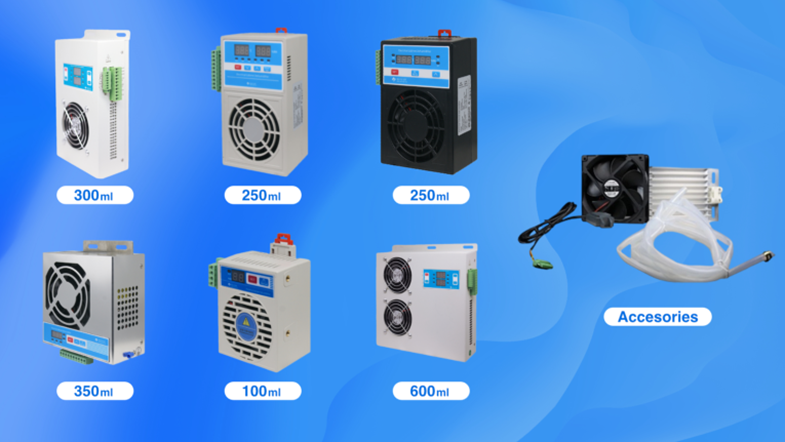
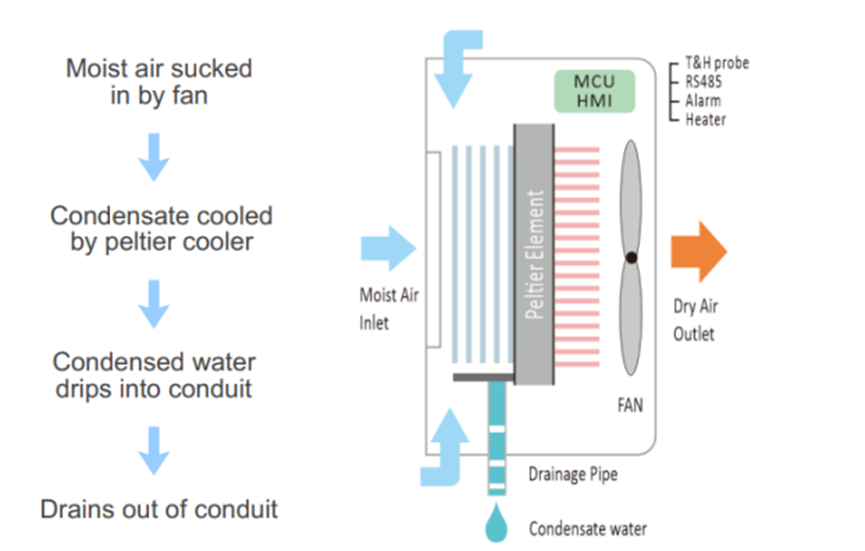
Thermoelectric dehumidifiers operate based on the Peltier effect, where a temperature difference is generated across a semiconductor module when a direct current is applied. One side of the module becomes a cold surface while the opposite side dissipates heat. Moist air inside the enclosure is driven by a fan across the cold surface, where water vapor condenses into liquid as it reaches the dew point. The condensate is collected and drained out, while the dried air is slightly reheated by the hot side and recirculated back into the enclosure, forming a continuous and closed-loop dehumidification process.
How compressor dehumidifier work?
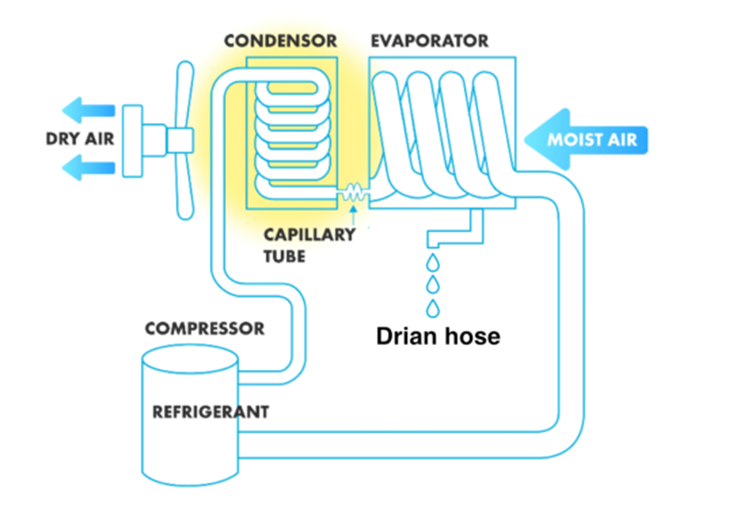
Compressor-based dehumidifiers rely on a vapor-compression refrigeration cycle, where moisture removal is achieved through refrigerant phase changes. The refrigerant is first compressed into a high-pressure, high-temperature gas, then cooled and condensed into a liquid in the condenser. After passing through an expansion device, it enters the evaporator as a low-temperature fluid, creating a cold surface. As moist air passes over the evaporator, water vapor condenses efficiently, enabling high-capacity dehumidification.
Peltier Dehumidifier vs Compressor Dehumidifier
Peltier (thermoelectric) dehumidifiers use semiconductor cooling, offering a compact, quiet, and low-maintenance solution ideal for small or noise-sensitive enclosures, though with limited capacity. Compressor dehumidifiers, based on vapor-compression refrigeration, provide higher efficiency and stronger performance in high-humidity environments, making them suitable for larger or more demanding applications, at the expense of size, noise, and maintenance.
| Category | Peltier | Compressor |
| Working Principle | Thermoelectric effect | Vapor-compression cycle |
| Heat Exchange Mechanism | Direct cold plate condensation | Evaporator forced cooling |
| Dehumidification Capacity | Limited by heat pump efficiency | High continuous latent heat removal |
| Thermal Efficiency | Moderate | Higher at scale |
| System Complexity | Low(no refrigerant loop) | High(full refrigeration system) |
| Response Time | Fast | Slight delay due to compressor cycle |
| Suitable Enclosure Size | Small to medium | Medium to large |
| Environmental Robustness | Moderate | Strong |
| Noise | Very low | Moderate to high |
| Maintenance | Low | Medium to high |
From a thermodynamic perspective, Peltier systems rely on solid-state heat transfer and electron transport, which inherently limits their cooling capacity due to material efficiency and heat dissipation constraints. Compressor systems, however, leverage phase-change refrigeration, enabling significantly higher latent heat removal and more stable long-term performance.
Conclusion
Peltier dehumidifiers are best suited for compact, low-noise, low-maintenance applications, while compressor dehumidifiers are preferred for high-capacity, high-humidity industrial environments. Selection should be based on enclosure volume, moisture load, and required operational reliability.