Confused whether to use a single phase or 3 phase DIN rail kWh meter for your distribution box, solar project or rental sub-metering? Though both share standard 35mm DIN rail installation, they differ drastically in load capacity, wiring structure and suitable applications. We compare them from different aspects to guide your quick selection.
What is Single phase DIN rail energy meter
A single phase DIN rail energy meter is designed for single-phase AC power systems, typically operating at 120 V or 230 V with one live conductor (L) and one neutral conductor (N). It measures electrical energy consumed by individual circuits or loads and is widely used in residential and light commercial applications.
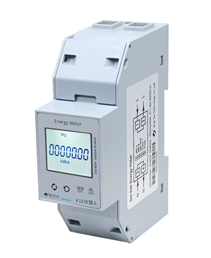
Modern single-phase meters are available in both direct-connected versions (commonly up to 80 A or 100 A) and CT-connected versions for higher-current applications.
What is 3 phase DIN rail meter
A 3 phase DIN rail energy meter is designed for three-phase electrical systems, including both 3P3W (three-phase three-wire) and 3P4W (three-phase four-wire) configurations.
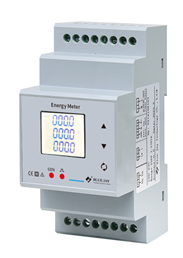
These din rail three phase meter meters typically operate at 400 V, 415 V, or 480 V, depending on regional standards, and are capable of monitoring balanced as well as unbalanced loads.
Three-phase meters are available in:
Direct-connected din rail three phase meter
CT-connected din rail three phase meter
High-current industrial metering solutions
Compared with single-phase meters, three-phase meters usually provide much richer electrical information, making them suitable for commercial and industrial energy management.
Key difference – single phase din rail energy meter vs 3 phase din rail meter
- Voltage and Load Capacity
Single-phase meter Voltage and Load Capacity
It operates on single-phase 220/230V line-to-neutral voltage. It only measures one independent load circuit, calculates power based on single-phase parameters, and is designed for low-power single-phase loads such as lighting and socket circuits. It cannot monitor separate loads on multiple phases or adapt to three-phase power supply systems.
Three-phase meter Voltage and Load Capacity
It supports three-phase 380V three-wire or 3×220/380V four-wire power supply, capable of measuring voltage on phase A, B and C separately. The meter calculates power for each phase individually and sums up total power. It accommodates balanced and unbalanced three-phase loads, matching medium and high-power three-phase equipment commonly used in industrial scenarios.
- Installation and Cabinet Space
| Single-phase meters | Three-phase meters |
| · Faster installation · Lower wiring cost · Reduced risk of wiring errors · Smaller cabinet footprint | · Additional wiring · More terminal connections · Larger DIN rail space · More careful phase sequence verification |
- Applications
| Single-phase meters | Three-phase meters |
| Rental apartments | Factory main distribution |
| Residential PV | Commercial PV systems |
| Small offices | Industrial automation |
| Coffee shops | Warehouses |
| Retail stores | Hospitals |
| Office lighting | Shopping malls |
| Tenant billing | Data centers |
| Single EV charger | Fast EV charging stations |
| Water pumps | Main incoming feeders |
- Function Comparison
Many users assume that single-phase meters offer only basic energy measurement while three-phase meters provide advanced functions. In reality, many core features are available on both types. They are Voltage, Current, Active energy, Reactive energy, Bidirectional energy measurement, Frequency, Power factor, Bidirectional energy measurement, Multi-tariff (TOU)
RS485 Modbus communication, Pulse output, Alarm settings.
However, High-end three-phase meters may additionally provide the following function:
Total Harmonic Distortion (THD), Harmonic analysis, Current/ Voltage imbalance, Phase angle, Maximum demand, Event recording, Load profile, Power quality monitoring.
It is important to note that these advanced features depend on the specific product model rather than simply whether the meter is single-phase or three-phase.
- Cost and Budget
Single-phase DIN rail meters feature lower unit purchase cost. They are a cost-effective option for projects only requiring single-circuit power metering. The overall budget investment stays minimal, with no extra requirement for supporting three-phase measurement hardware, making them ideal for budget-limited single-load monitoring applications.
Three-phase DIN rail meters carry higher unit pricing due to multi-phase measurement circuitry. For systems needing three-phase load monitoring, this type avoids deploying multiple single-phase meters. Though the upfront cost is higher, it can deliver better long-term budget efficiency for three-phase power distribution projects.
However, for commercial and industrial projects, the additional investment is often justified by improved monitoring capabilities and higher system reliability.
- CT Matching Requirements
Single-phase din rail meter only requires one set of current transformer for single live wire sampling. Matching parameters are simple, only one CT specification needs to be confirmed. No phase synchronization requirement exists, and wiring and model selection bring fewer matching restrictions for single-circuit measurement.
Three-phase DIN rail meter needs three matched current transformers for Phase A, B and C respectively. The three CTs must adopt consistent rated ratio, accuracy class and performance parameters to guarantee balanced metering. Strict phase correspondence between CTs and each input channel is mandatory, bringing higher overall matching standards.
When Should You Choose a Single Phase DIN Rail Energy Meter?
A single-phase DIN rail energy meter is ideal for low-power applications such as rental apartments, residential homes, office lighting, small retail stores, coffee shops, residential solar systems, tenant sub-metering, small workshops, and single EV chargers. With its compact design, simple wiring, and cost-effective installation, it is a practical solution for residential and light commercial energy monitoring.
When Should You Choose a 3 Phase DIN Rail Energy Meter?
A three-phase DIN rail energy meter is designed for higher-power applications, including commercial PV systems, factory distribution panels, industrial machinery, warehouses, hospitals, shopping malls, data centers, large HVAC systems, fast EV charging stations, and main incoming feeders. It provides higher load capacity, more comprehensive electrical measurement, and better scalability for commercial and industrial energy management.
Conclusion
Single-phase and three-phase DIN rail energy meters are designed for different applications. Single-phase meters suit residential and light commercial loads, while three-phase meters are ideal for commercial and industrial systems requiring higher capacity and advanced monitoring. The right choice depends on the voltage system, load requirements, installation conditions, and future expansion needs.